Road Trippin’ into 2025!

Happy 2025! After a fun New Year’s Eve celebration in Nashville, raving to Sofia Kourtesis, a Peruvian-born, Berlin-based DJ, at the club Nigh We Met, I decided to kick off the new year with some exploring, hiking, and high-pointing. Why not start the year on a literal and figurative high note, right? Having visited 32 of the 50 Best State Parks (as noted by the travel blog The Discoverer), I still have a lot of ground to cover—literally! And with 32 of the 51 State High Points (yes, they’ve included the District of Columbia, because why not?) already under my belt, I figured 2025 was as good a year as any to tackle the rest. On the map below, red tree markers represent the parks I have yet to visit, while yellow mountain markers show the high points I still need to summit. For simplicity’s sake, I left out Alaska and Hawaii on the map, but rest assured—both their state parks and high points are on my list!

Photo: My Adventure Map – High Points and The Best State Parks

My road trip plan? Start in Nashville, cruise across the plains to Colorado, swing down to New Mexico, and then roll through the Southwest all the way to San Diego. Of course, no great road trip is complete without its hiccups—and mine came in the form of Flu A midway through. Spoiler alert: I’ll share all the gory details in my upcoming post about Panorama Point, the highest natural point in Nebraska. For now, let’s focus on the first big highlight of my trip: Historic Lake Scott State Park.

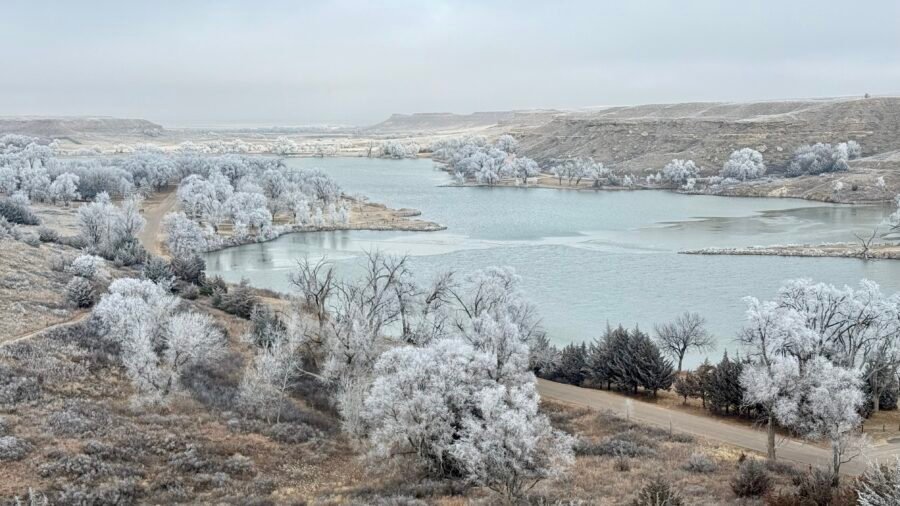
Nestled in the high plains of western Kansas, this hidden gem was my first stop. I haven’t spent much time in the Plains before, and honestly, that’s my bad. This region is stunning in a way that sneaks up on you, and Historic Lake Scott proved to be a winter wonderland. Picture frost-covered trees glittering in the morning sun and a peaceful stillness that made it feel like I had the whole park to myself. Sure, it was a brisk 18 degrees, but the solitude and beauty made it totally worth bundling up. If you’re picturing a place known for camping and summer lake vibes, you’re not wrong—but trust me, winter here is something truly special.

Photo: The Southern Entrance to Historic Lake Scott State Park

An Unexpected Oasis: Kansas’ Hidden Gem

Located about 35 miles south of Interstate 70 or just 15 miles north of Scott City, Kansas, Historic Lake Scott State Park is a stunning 1,000-acre oasis of rugged canyons, rolling prairie, and lush woodlands. At its center lies the spring-fed Lake Scott, a sparkling gem framed by dramatic chalk bluffs and graceful cottonwood trees. The park’s striking terrain stands in vivid contrast to the surrounding plains, creating a picturesque retreat that feels like a hidden paradise for nature lovers.

The park’s elevation changes—a rarity in Kansas—create a landscape that feels almost otherworldly. The combination of natural springs, vibrant vegetation, and rocky outcrops attracts not only visitors but also a diverse array of wildlife. It’s a perfect destination for anyone seeking an escape into nature. Whether you’re an avid adventurer or a casual day-tripper, Historic Lake Scott State Park delivers something special for everyone: scenic trails for hiking and biking, water-based recreation, camping, opportunities for wildlife watching, and a chance to explore fascinating historical sites.

A $5 Pass and Watchful Eyes

As I drove south on Kansas 95, my first glimpse of Lake Scott prompted an impromptu pull-over to snap a few pictures of the serene landscape. Next on my agenda was a visit to the Park Office—not just to pay the $5.00 Daily State Parking Permit fee but also to get the lay of the land. While there is a convenient pay station, I always prefer stopping by the office. It’s a great chance to pick up park insights and, if I’m lucky, snag some postcards to send to friends and family. Unfortunately, this time there were no postcards, but the ranger more than made up for it with helpful tips and a warm welcome.

Photo: Lake Scott

As I stepped outside, something high above the Park Office caught my eye—two striking figures of Native Americans standing on the ridge, watching over the park. I immediately knew I had to explore the ridge and see them up close. This area was once home to the Plains Apache, who left behind fascinating remnants of their lives, such as tools and petroglyphs. Later, it became a historically significant site for the Northern Cheyenne. Suddenly, those figures on the ridge felt like much more than art—they were a meaningful nod to the people who had walked this land long before us.

Photos: Park Office | Self-Pay Station

Photo: Park Map

Let’s Find those Indians!

The park boasts several miles of trails that meander through its wonderfully diverse landscapes, catering to hikers, horseback riders, mountain bikers, and nature lovers alike. A quick heads-up: trail names can vary depending on your source, and the signage isn’t exactly stellar. But don’t worry—you won’t get lost (promise!). Just be ready for a bit of a challenge, especially on the rugged West Bluff Trail.

I kicked off my first hike from the Big Springs Picnic Area, which offers two short but sweet trail options: the 0.4-mile Sunflower Trail and the 0.4-mile Big Springs Nature Trail. Fun fact (perhaps): the Sunflower Trail is actually part of the Big Springs Nature Trail. From Big Springs, I caught sight of the iconic Indian on horseback perched on the bluff—a preview of the adventure ahead.

Photos: Big Springs Picnic Area | Big Springs, if you zoom in, you can see the Indian on the Bluff (center)

There’s a bridge near the picnic area that I crossed initially, but I ended up doubling back and taking a trail to the left of it instead. That trail eventually led me up to the bluff. The path wasn’t exactly well-worn, so I took it slow on the way up—no need to rush when there’s so much natural beauty to soak in.

Photos: The Bridge at Big Springs | The Big Springs Nature/Sunflower Trail

From the top of the bluff, the views were absolutely stunning—sweeping vistas of the park’s dramatic terrain. And yes, I finally made it to the two elusive Indian statues! After some time enjoying the scenery, I looped back down on the far side of the spring. Honestly, it felt like more than 0.4 miles, but who’s counting when you’re on an adventure like this?

Photo: View from the Bluff

Photos: The Indians on the Bluff

Photos: Big Springs | Bird Statues in the Springs

Kansas History for 200, Ken

Back in 1888, Herbert Steele staked his claim in Scott County and decided the future state park area was perfect for homesteading. Five years later, he married Eliza Landon, and they began their pioneer life in a humble dugout. Over time, they upgraded to a four-room sandstone house, with materials handpicked from the surrounding bluffs. Talk about an ambitious DIY project! Their preserved home, now a museum, offers a peek into the tools and furnishings of the 19th century—and yes, they wanted their homestead to become a public park. In 1928, their dream came true when the Kansas Forestry, Fish and Game Commission took over 1,280 acres, including the Steele homestead. I swung by their old homestead, curious to explore, only to discover that tours require pre-arranging with the park office. A mild bummer, but hey, I had trails to conquer.

Photos: Steele Home Museum | I guess Santa left his sleigh

Photos: The back of the Steele Home Museum | Lake Scott behind the Museum

How Many Bluffs Does It Take to Question Your Life Choices?

Across the road from the homestead was a trailhead, so I parked my car, glanced around at the nearly deserted park, and headed up. And by “up,” I mean a steep climb where the trail splits into a guessing game of “Which way won’t make me regret my life choices?” Depending on who you ask, this is either the Lake Scott West Loop or the West Bluff Trail. Either way, I braved the 2.9 miles of loops and out-and-back paths to reach the top.

Photos: The Trailhead and the Mysterious Building | The Trail up to the Bluff

Photo: It was brisk – frost-covered tree

At the summit, there’s a mysterious building (purpose unknown) and the Steele Monument, which offers jaw-dropping views. From there, I scrambled down and then up again to the next bluff—because why stop at one steep climb when you can tackle two?

Photos: The Mysterious Building | The Steele Monument

Photos: Views from the Building

Back on the valley floor, the trail flattens out, lulling you into a false sense of security before you spot another bluff. This one features a bench perched dramatically at the top, called Buzzards Point. Naturally, I couldn’t resist climbing it, even though the ascent had me questioning my sanity. From Buzzards Point, I spied yet another bluff crowned with an American flag and another bench. Yes, of course, I climbed that one too.

Photos: Atop Buzzard’s Point

Photos: The Views of Lake Scott from Buzzard’s Point

Photo: You can barely see the Flag on the Bluff in the distance – notice the trail to the top!

Photos: The trail to the Bluff with the American Flag | Atop the Bluff with Old Glory

Photos: Looking down at the Point with the Bench | The trail I just came down from the Bluff Top

Photo: View from the Point

Eventually, I reached the end of the bluffs and spotted a herd of white-tailed deer—who promptly dashed away before I could snap a photo. At this point, AllTrails completely ghosted me, and I found myself following what seemed like a trail but might have been an ambitious deer path. Shortcut or not, it got me down to the valley floor. The way back was mostly flat and followed the road, with some sections doubling back and others skirting the base of the bluffs. I finally made it back to my car, scarfed down a snack, and geared up for the next leg of my adventure. Because when you’re in a place like this, the explorations never really end!

Photo: The winding trail back to my car

Kansas History for 1000, Ken

Just down the road lies El Cuartelejo, one of Lake Scott’s most significant historical sites. El Cuartelejo holds the distinction of being the northernmost pueblo in the United States. Built in 1664 by Taos Indians fleeing Spanish rule, the pueblo was constructed using stone from nearby hills, with walls plastered in adobe and roofs made from willow poles and mud. In 1696, Picuris Indians briefly reoccupied the site. By 1727, it was abandoned due to Comanche and Pawnee attacks. Rediscovered in the late 19th century, the site was excavated and restored in 1970. Today, visitors can explore this National Historic Landmark and its reconstructed foundations.

Photo: A depiction of the Pueblo as it might have appeared in its prime

Photos: The sign at the parking lot marks the start of a short walk to the ruins | El Cuartelejo Monument | Historical Marker with detailed information

Photos: The Pueblo Ruins | A Detailed Floor Plan

Stagecoaches and Fishing: Living the Frontier Dream

Earlier at the park office, the ranger mentioned a unique new addition: a rentable stagecoach. This quirky overnight option seems to be trending in parks, as I recently spotted one at Fort Ransom State Park in North Dakota. The stagecoach is located near a couple of cozy rental cabins, offering more options for a memorable stay.

Photo: The Stage Coach

To wrap up the day, I headed to the beach. The area boasts a large campground and a spring-fed, crystal-clear lake that’s ideal for swimming, kayaking, and paddleboarding on warmer days. Anglers will love the well-stocked waters, home to largemouth bass, crappie, bluegill, and channel catfish. With fishing piers, boat ramps, and even a small beach, there’s something here for everyone to enjoy.

Photos: Lake Scott from the Beach | A chilly Lake Scott

Best Times to Visit

While the park is open year-round, spring and fall are often considered the best times to visit. In spring, blooming wildflowers blanket the landscape, while fall transforms the cottonwoods into a striking palette of gold and orange, all under comfortably mild weather.

Summer brings its challenges with the heat, but the lake provides a refreshing escape. Winter visits, though less common, reveal a different kind of charm, as I can attest to. The snow-dusted bluffs and the frozen lake create a serene, almost otherworldly beauty that’s worth braving the chill to experience.

Wrapping Up: Highs, Bluffs, and Winter Wonders

And that’s a wrap on Historic Lake Scott State Park, my first stop of 2025. With its frosty trees and rugged bluffs, it was a pleasant surprise to kick off the year. The park’s winter charm—snow-dusted landscapes and peaceful solitude—made it a great spot for some quiet exploration.

The trails were a good challenge (even if I did question my sanity a few times), and the views from the top were definitely rewarding. It wasn’t the most jaw-dropping place I’ve ever visited, but it offered a solid mix of history, nature, and a little adventure.

So, with one park down and a whole year ahead of me, it’s safe to say 2025 is shaping up to be a pretty incredible adventure. Here’s to the next stop—and whatever unexpected surprises it has in store!

Catch you on the trail!

Date of Visit: 3 January 2025

Rest Stop Realities . . .

Ah, the joys of public rest stops – these are from Missouri. A place where the signs seem to exist more as a warning about human behavior than actual helpful tips. Case in point: one sign urging us not to wash dishes or blow our noses in the sink. I get the dishes—totally with you on that one—but blowing your nose in a public sink? Gross, guys. It’s a sink, not a tissue box! And the other sign—please don’t spit tobacco in the urinal? I mean, who exactly thought that was a good idea in the first place? These signs really make you question what led us to this point as a society. Ah, the life of humanity!