sharing my love for philanthropy, cooking, and adventure

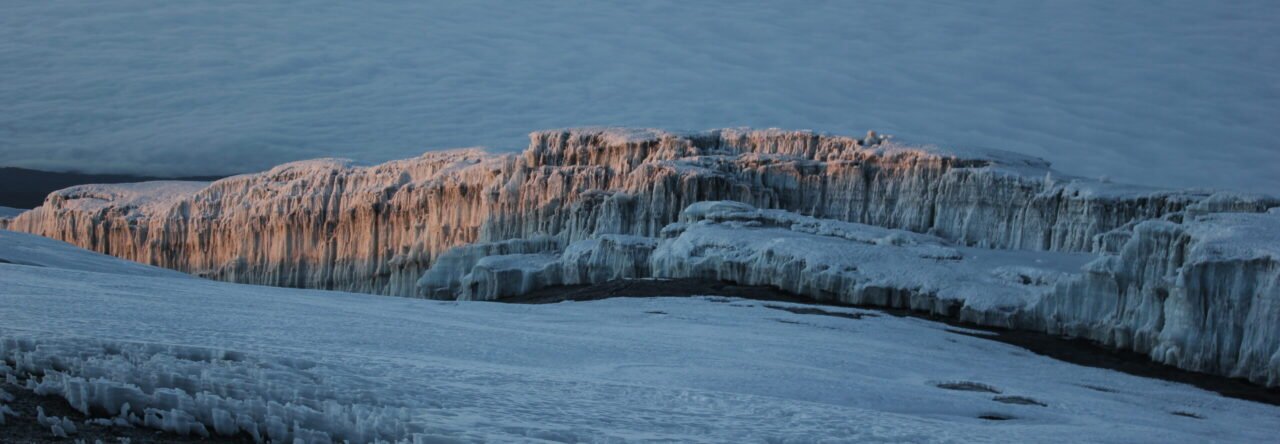
Sunrise illuminating the summit glacier on Mount Kilimanjaro, with ice formations in the foreground and a sea of clouds in the background.

Tag: Waterfalls Page 1 of 2

Tettegouche State Park | Minnesota | Part 2

The Adventure Continues: Tettegouche Redux

After soaking up the high from conquering Eagle Mountain and exploring Grand Marais, it was time to return to Tettegouche State Park and my new campsite. The drive back from Grand Marais was a pleasant hour, and I swung by the visitor center to check in again (see Part 1 of my adventure here).

My new site was further into Baptism River Campground, and I was genuinely impressed. The layout of this campground is top-notch—each site has its own space, so you’re not cheek-to-cheek with your neighbors. Of course, there was that one guy with the generator humming in the distance. I thought most of these sites had electricity? Maybe he missed the memo.

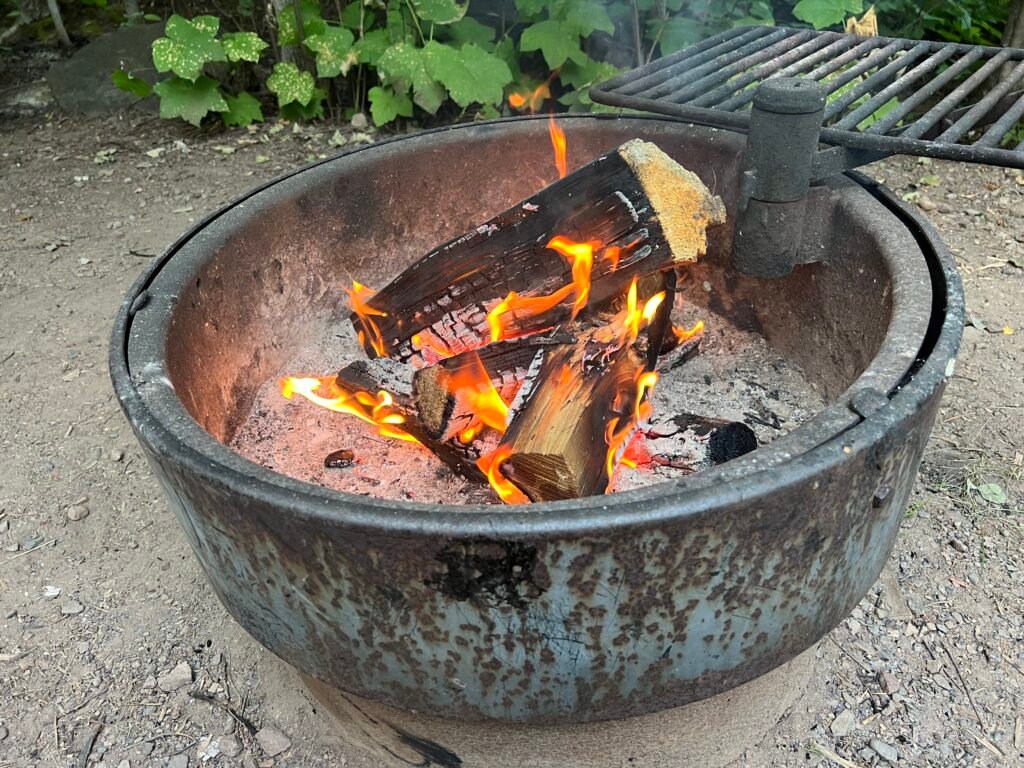
Evening came with a roaring fire, a glass of red wine, and one of my go-to camping meals: Yellow Tadka Dal from Trader Joe’s and Earthly Grains Basmati Rice from Aldi. These shelf-stable wonders were easy to whip up in my trusty cast iron skillet (a miracle I managed to pack it in my suitcase!).

Photo: Fireside Bliss Under the Evening Sky

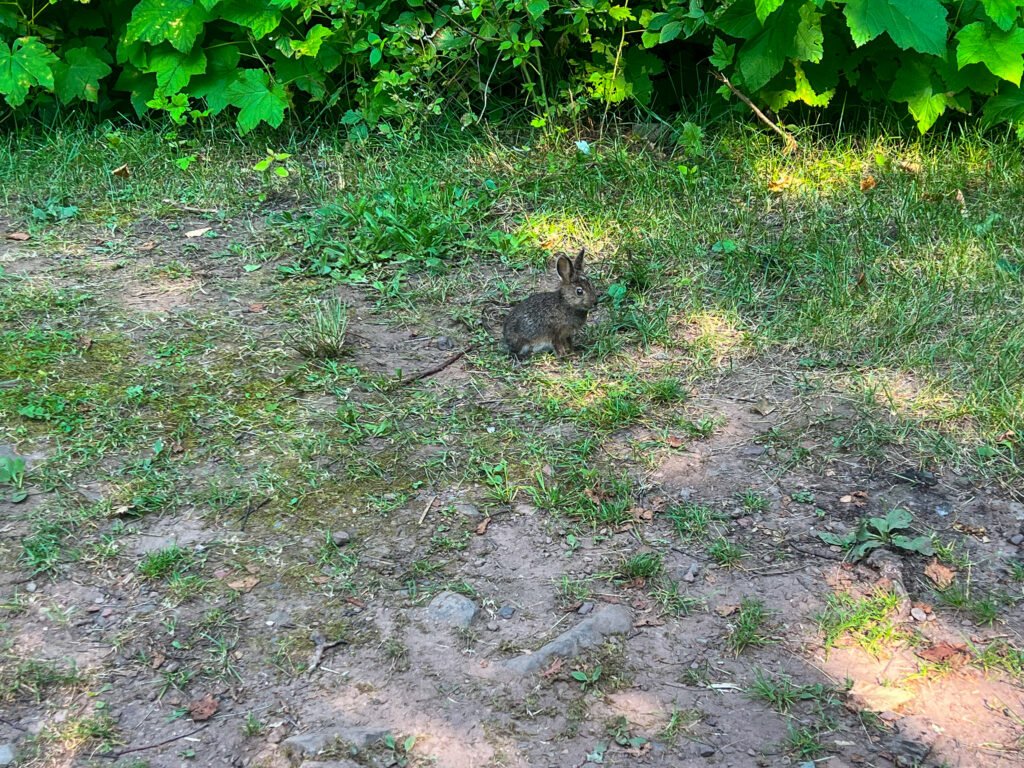
Morning Visitor: The Hare-Raising Encounter

Up and at it early again! I started my day with cold brew coffee and a splash of Coffee Mate (not ideal, but it lasts longer than real half-and-half in the wild). While soaking in the peaceful morning vibes, a snowshoe hare popped by for a visit. Fun fact: In Minnesota, these hares are dark brown in summer, but their coats turn snowy white in winter—a true fashion transformation known as leucism.

Photo: My Morning Visitor

Two Waterfalls, Twice the Fun

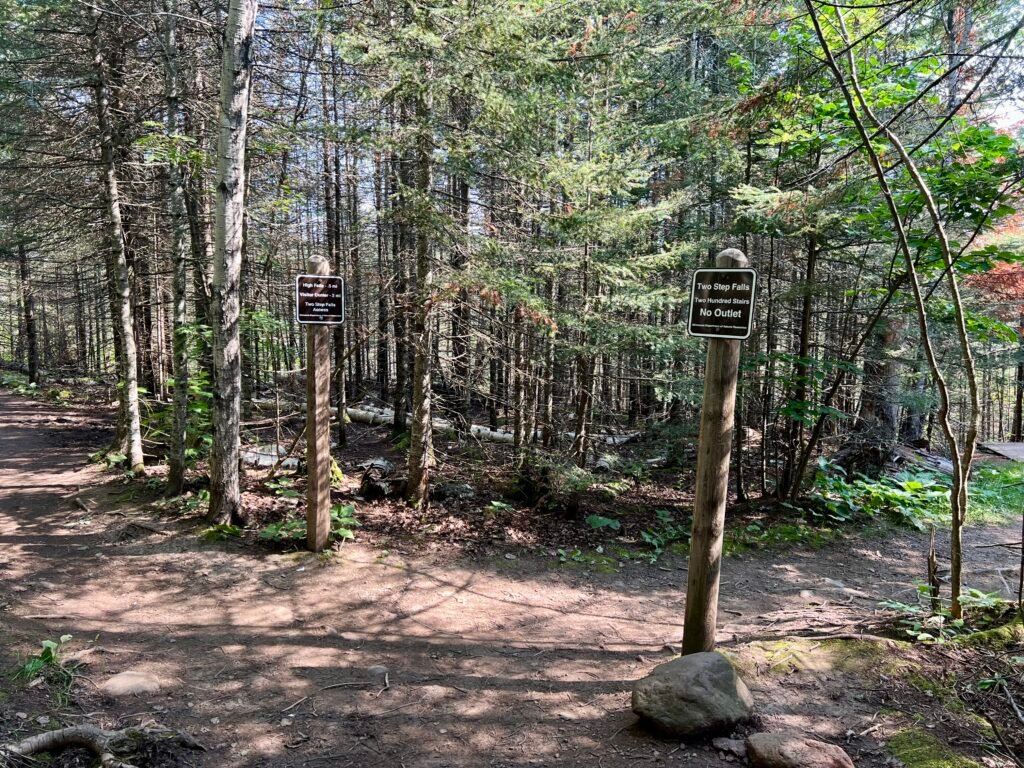
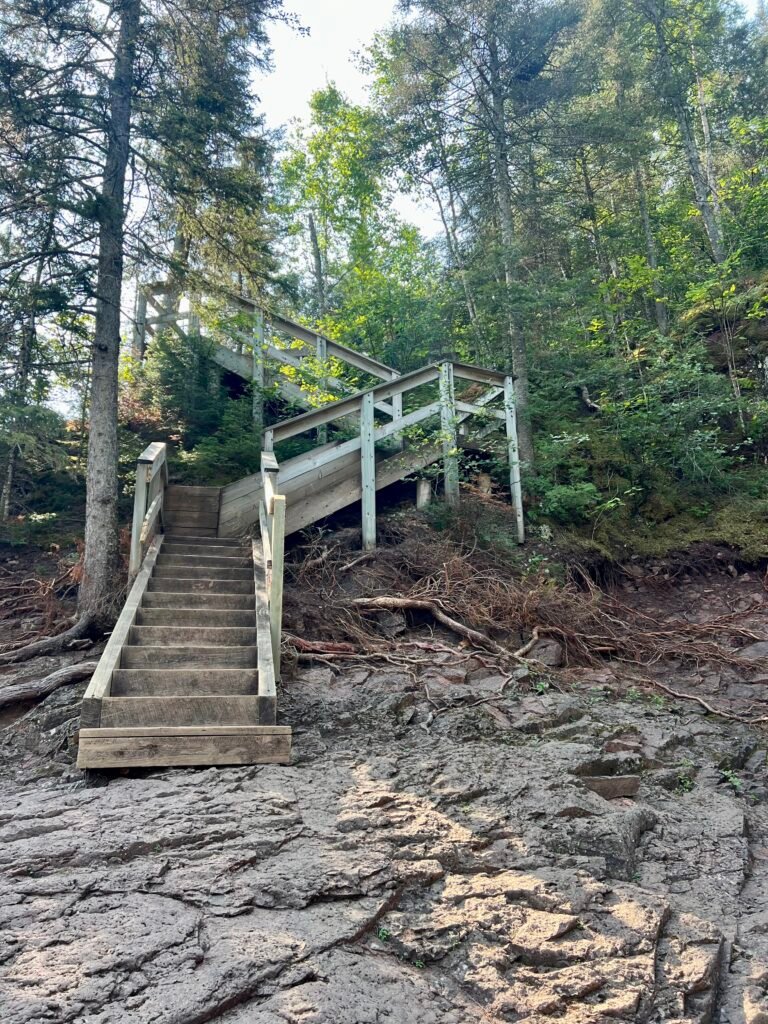
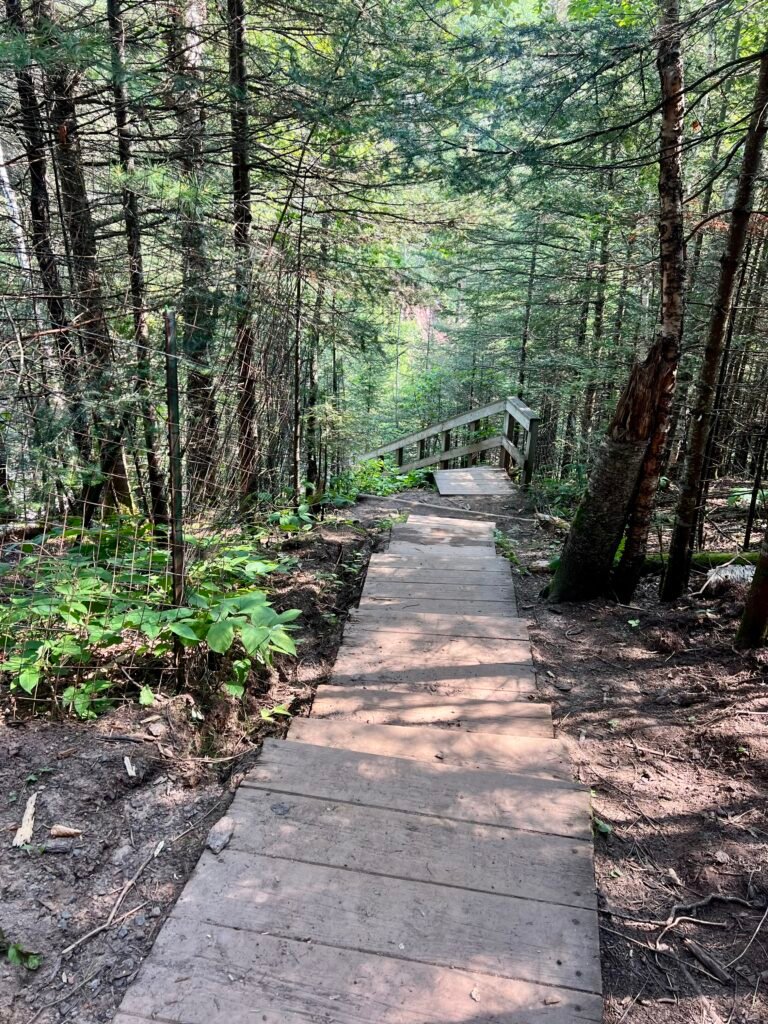
With clear blue skies overhead, I set off to see Two Step and High Falls from a fresh angle. The trailhead near Baptism River Campground gives you access to both falls, but from the opposite side of the river. I started with Two Step Falls, which came with a hefty 200-step descent—talk about earning your view!

Photos: The Trail and the Stairway to Two Step Falls

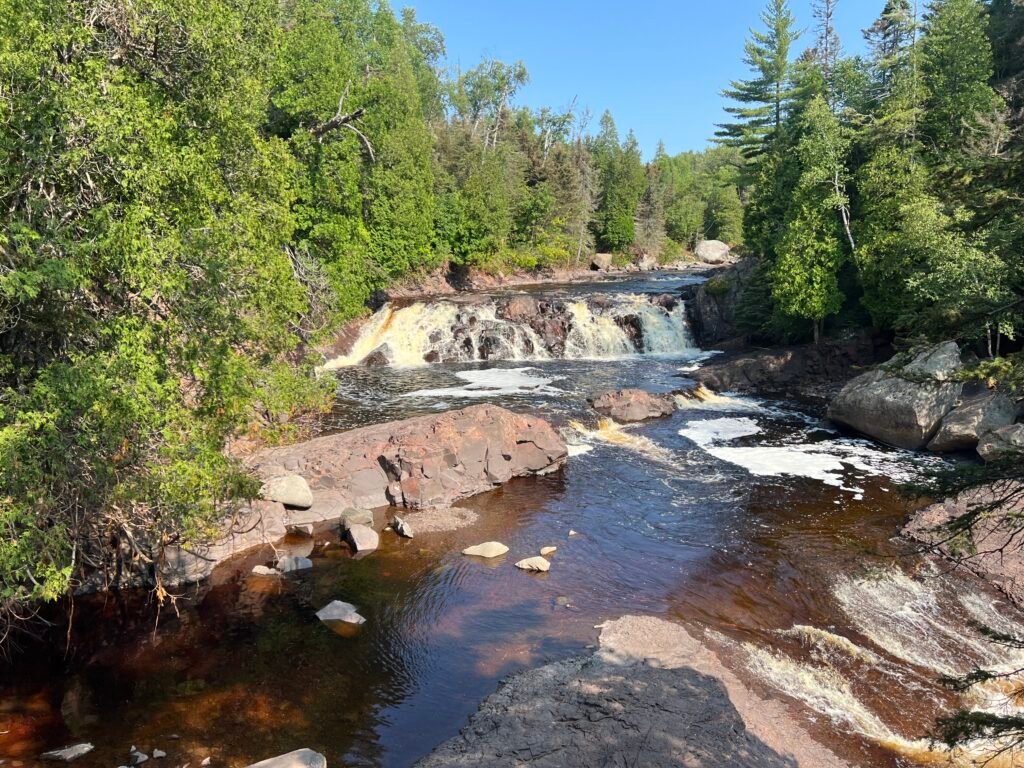
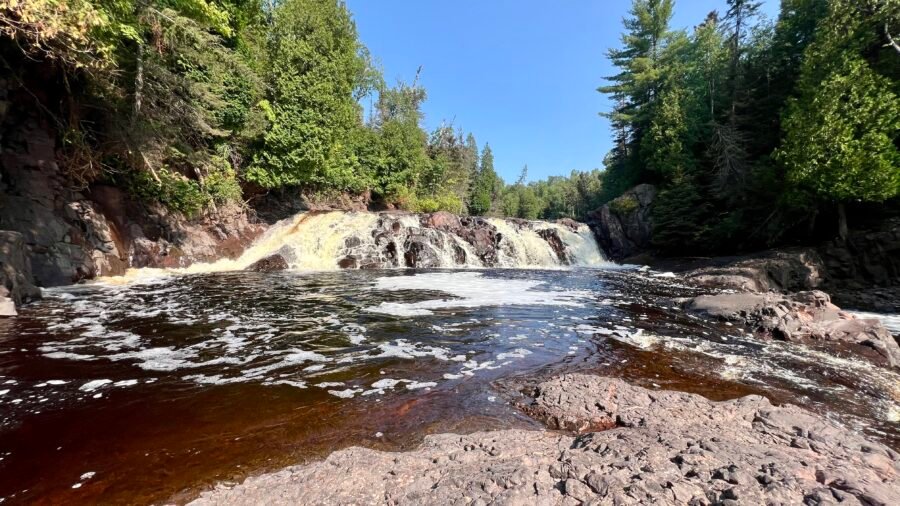
This view of Two Step Falls was absolutely breathtaking—definitely my favorite angle. I waded through the shallow waters to get up close, and was soon joined by a couple of guys with their eager dogs. I’m pretty sure the dogs were eyeing my adventure with a hint of envy, wishing they could splash around too!

Photo: Descending to Two Step Falls—Morning Magic in Every Step!
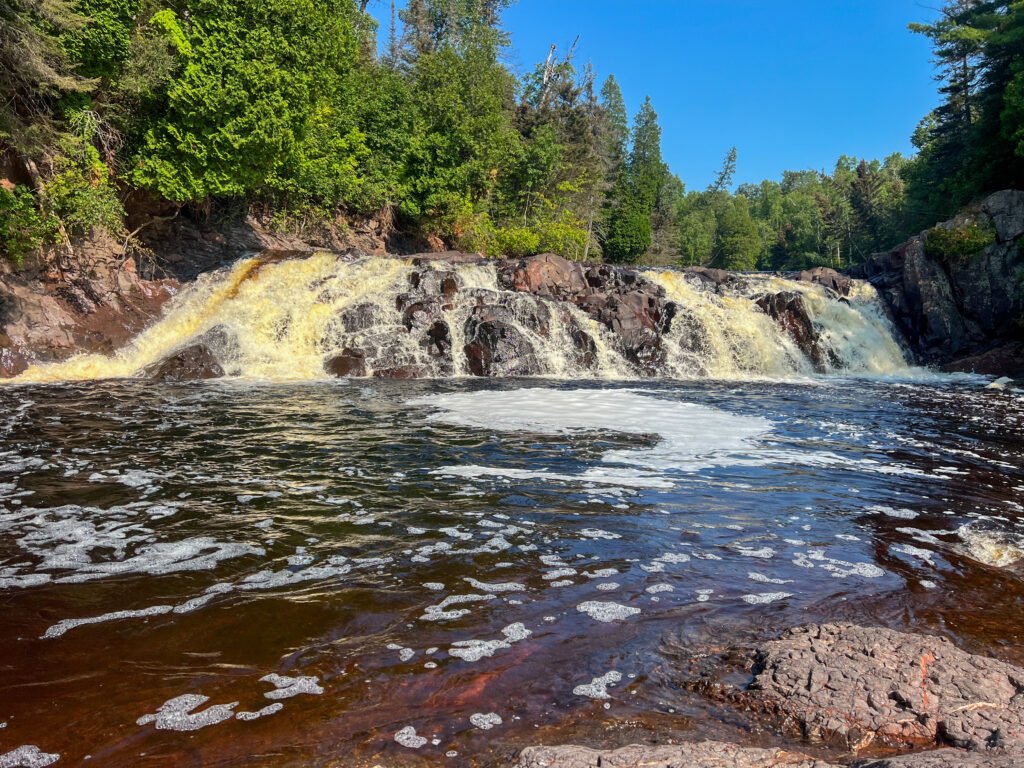
Photo: Getting Up Close and Personal with Two Step Falls

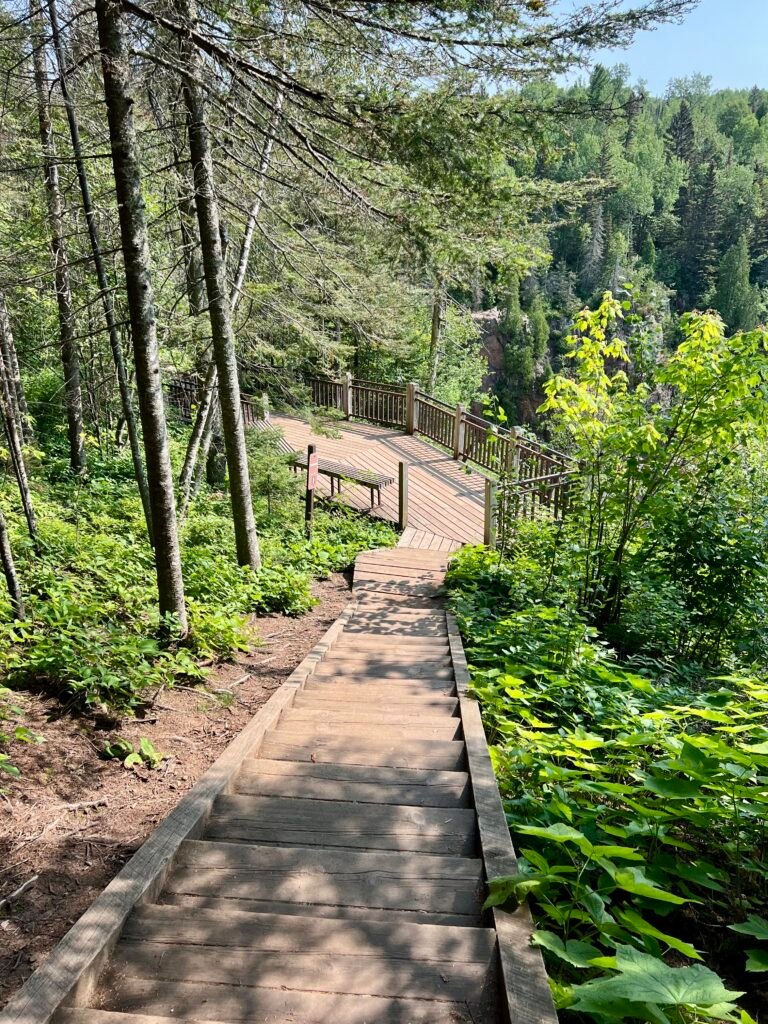
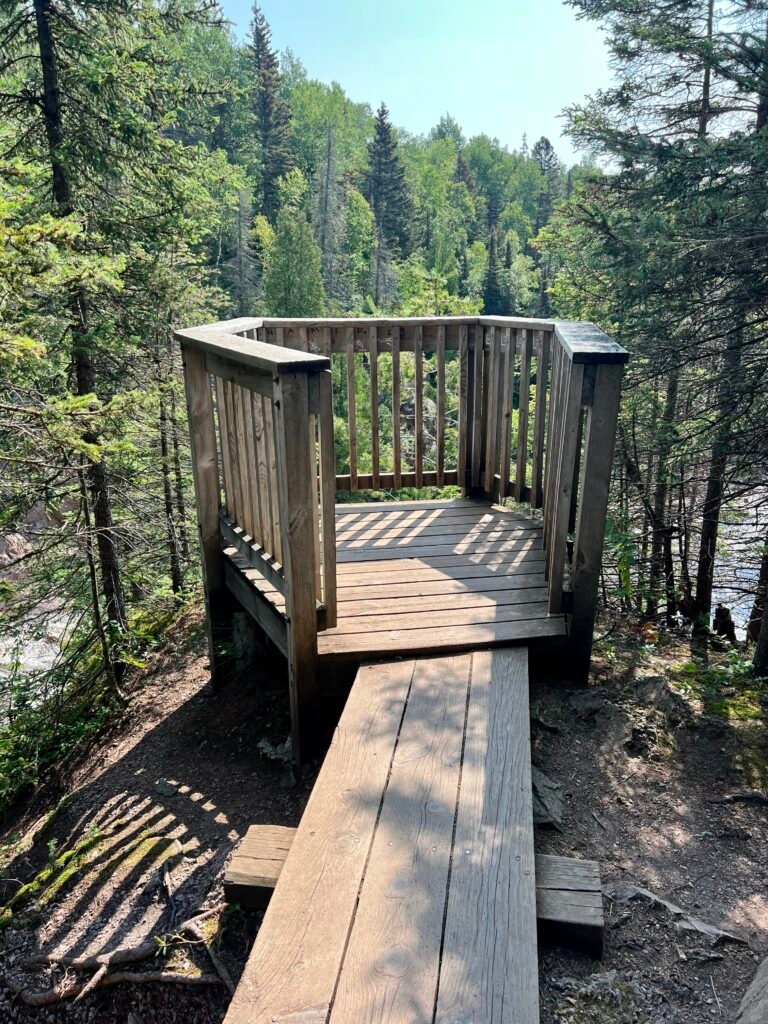
As I hiked along, I came to a fork in the trail—left to the parking lot (for the non-campers) or straight ahead to High Falls. Naturally, I went for the High Falls route and was rewarded with a spacious overlook and a dramatic, pulpit-like platform. I couldn’t resist the urge to give an impromptu sermon to the forest creatures from my new perch.

Photos: High Falls Viewing Area | The Legendary Pulpit Spot!

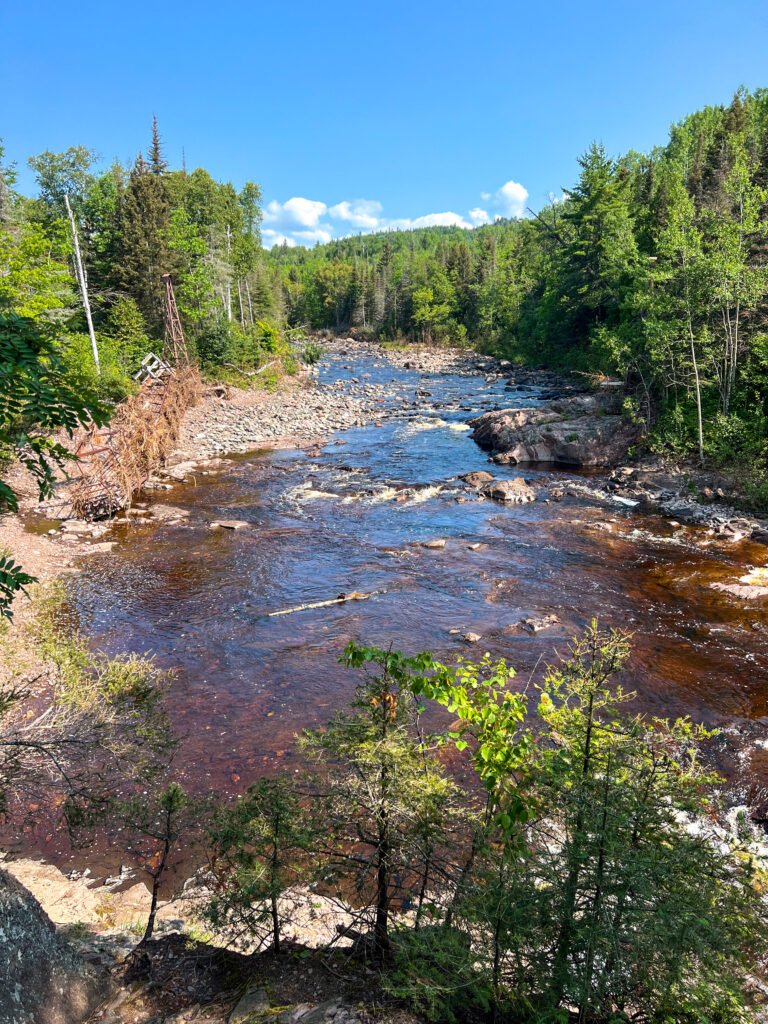
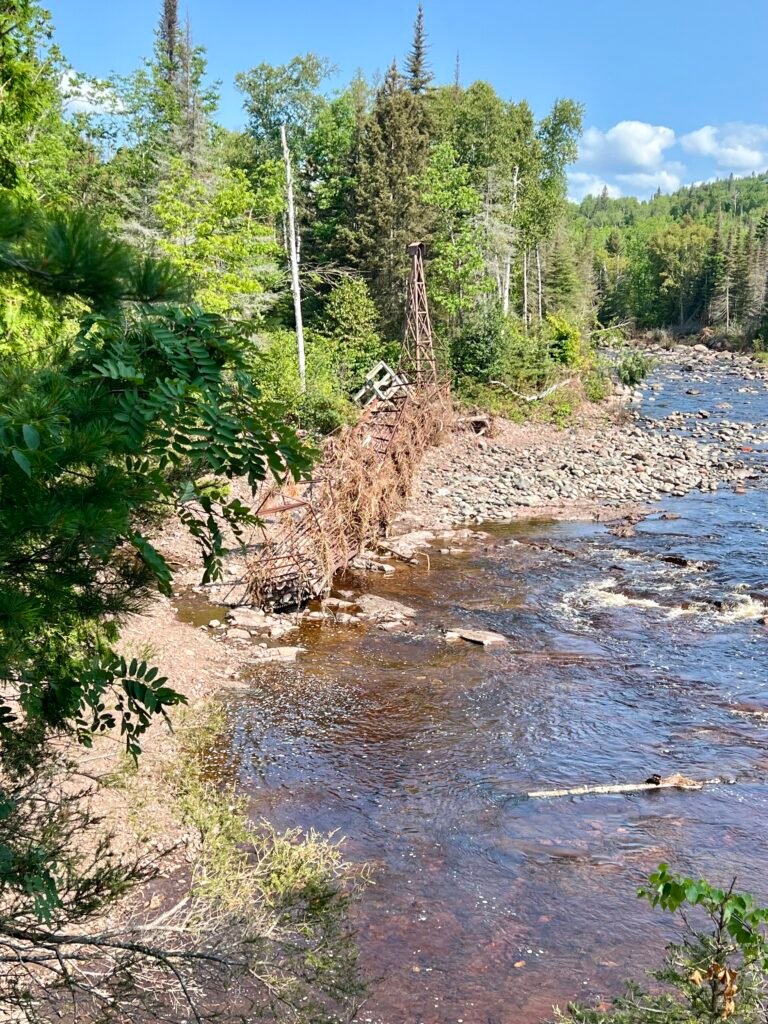
The river views were spectacular, although the opposite side provides a better vantage of High Falls. I also came across the twisted wreckage of the swinging bridge—evidence of a storm that had made quite an impact.

Photos: Breathtaking Views of the Baptism River
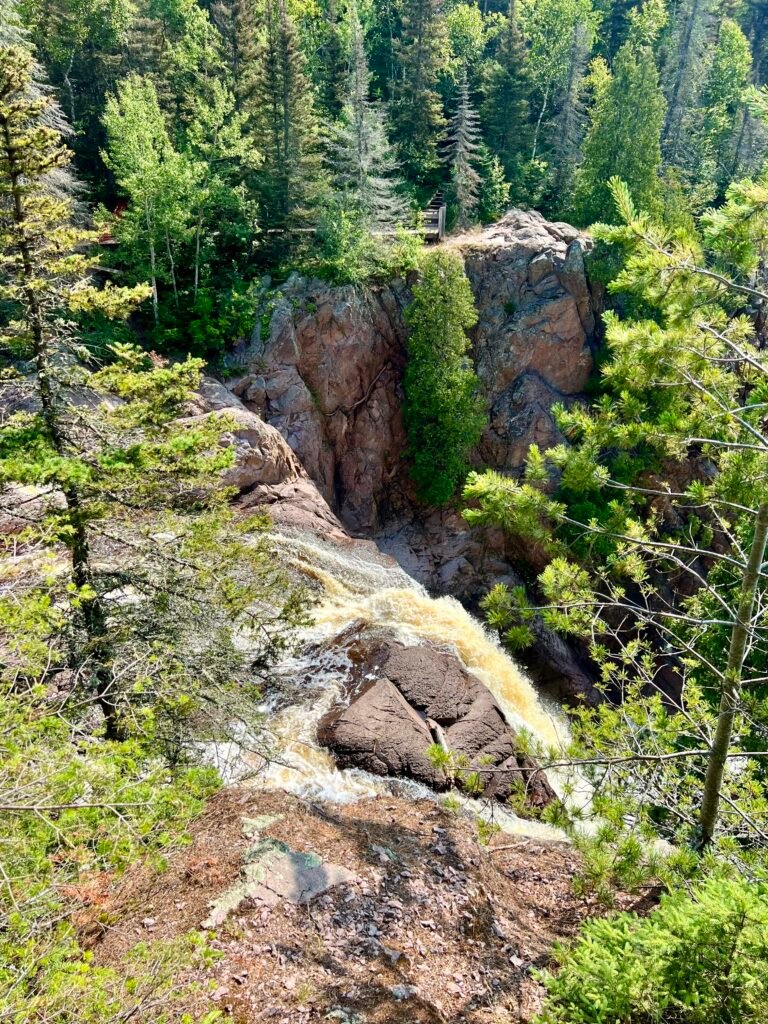
Photos: High Falls from a Different Angle—Less Spectacular, but Still Stunning | The Twisted Swinging Bridge

Take Two: Shovel Point and the River Mouth

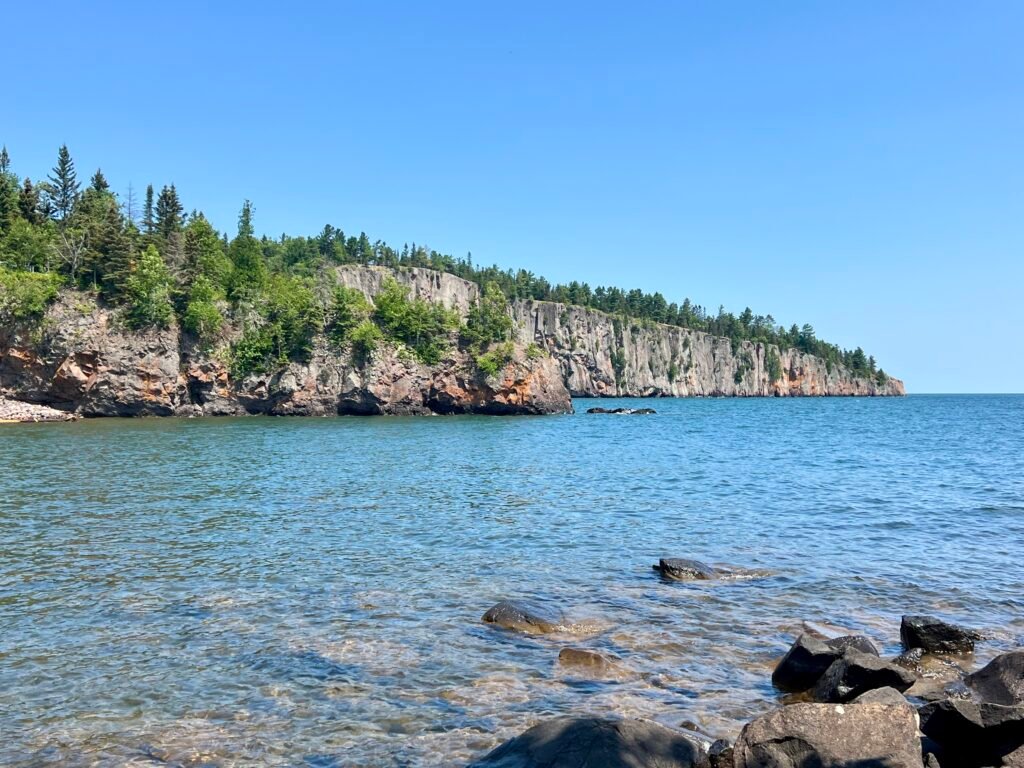
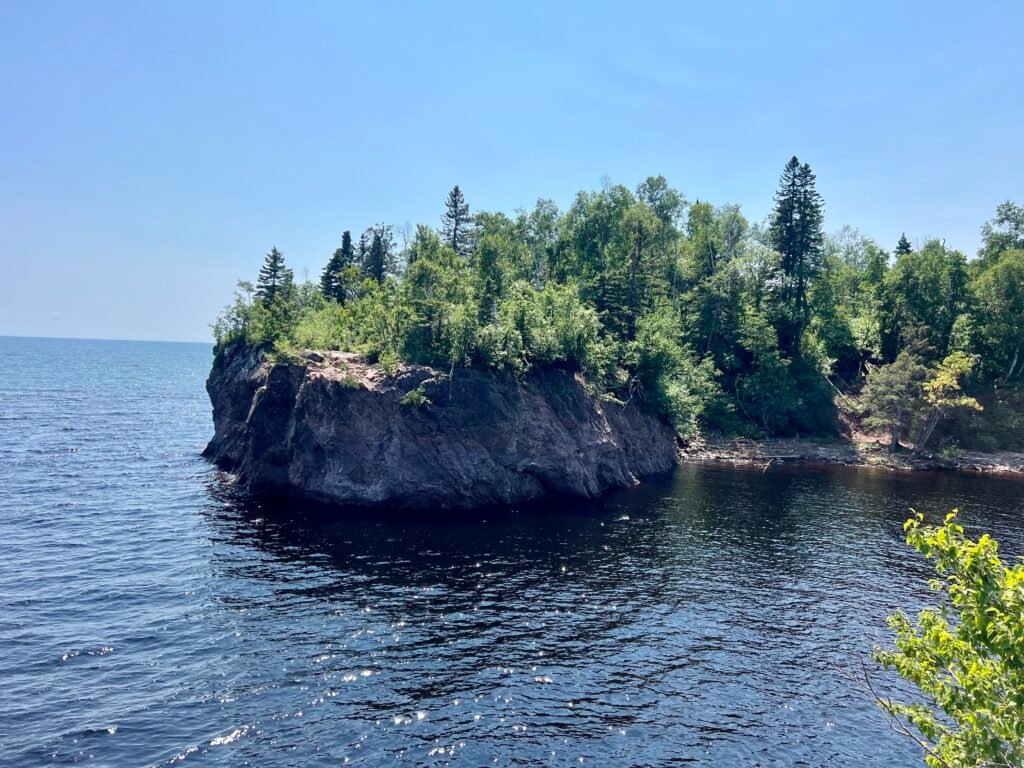
After packing up, I made my way back to the visitor center and then hiked out to Shovel Point and then to the River Mouth. What a difference a couple of days can make! With the weather finally on my side, the park was busier but still a blast. The calm Lake Superior and turquoise waters at Shovel Point were mesmerizing. I chatted with a friendly couple and admired the view.

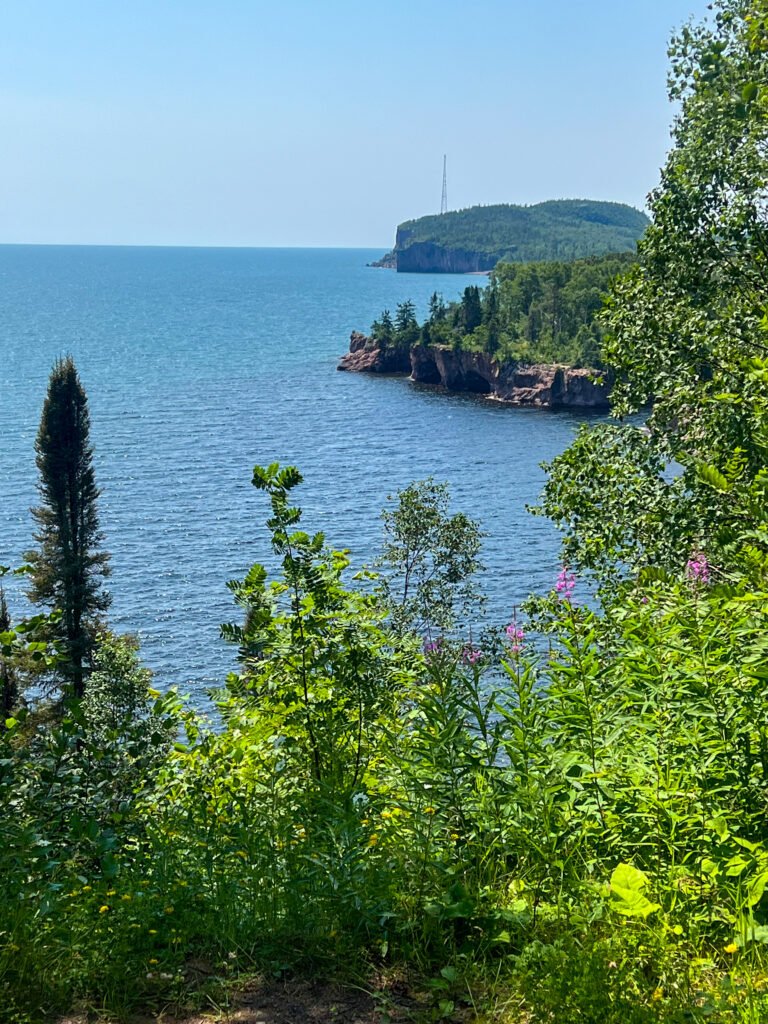
Photos: A Calmer Lake Superior – View from the Beach | Palisade Head in the Distance
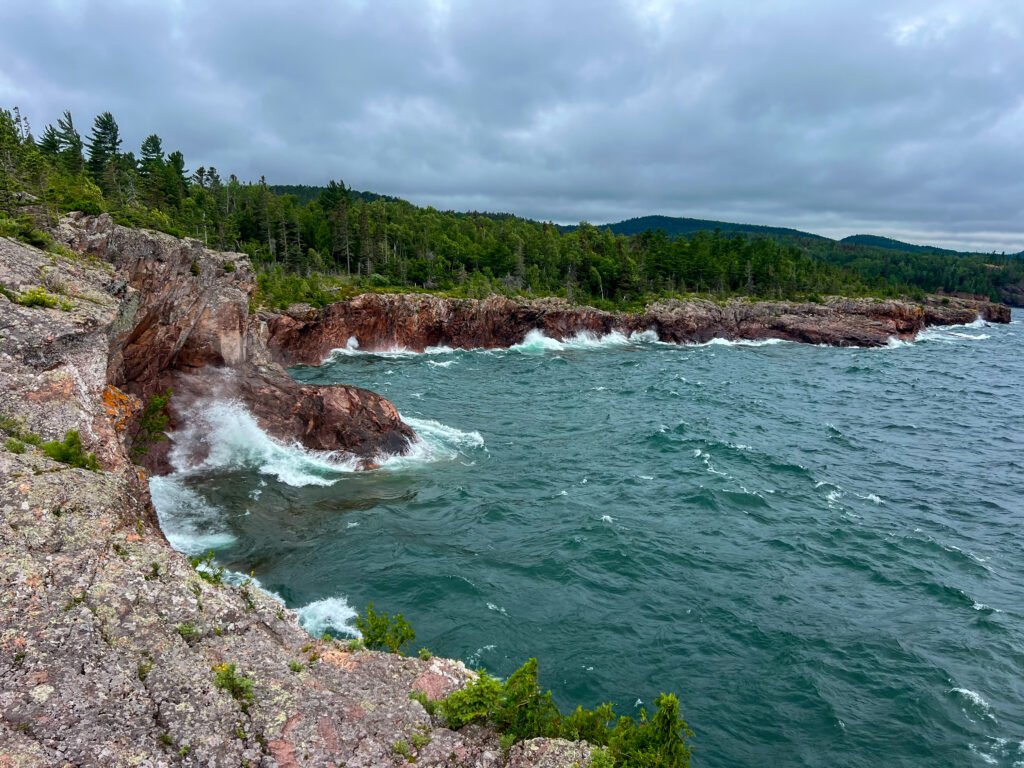
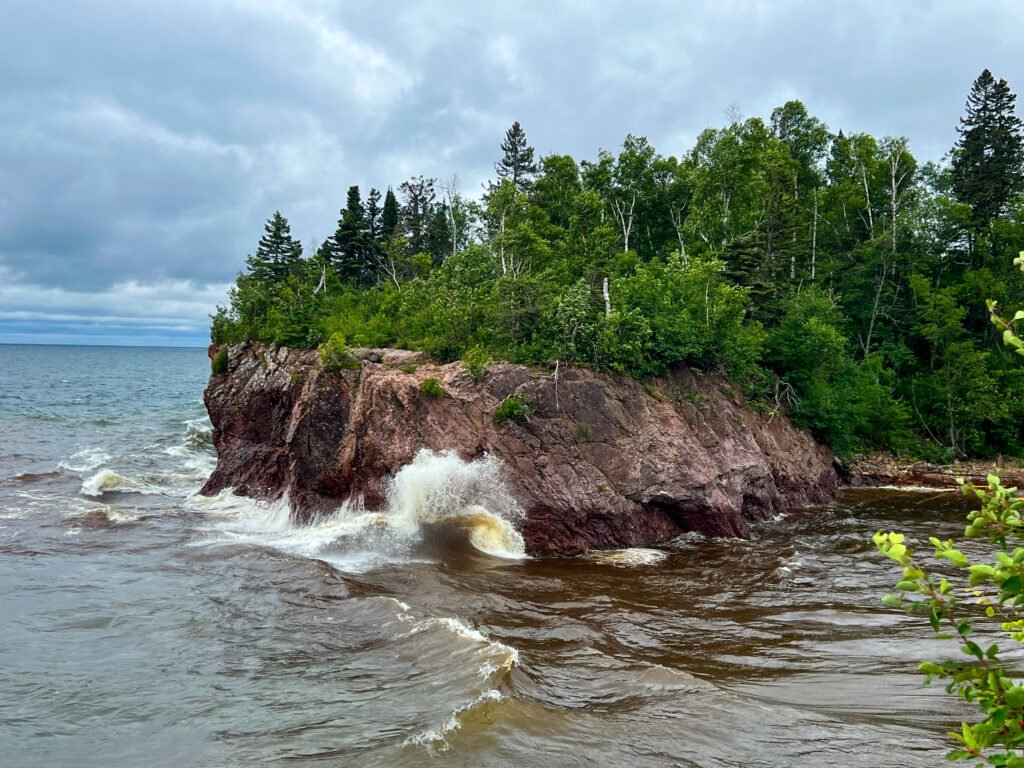
Photos: Lake Superior’s Dual Personalities—Two Days, Two Vibes!
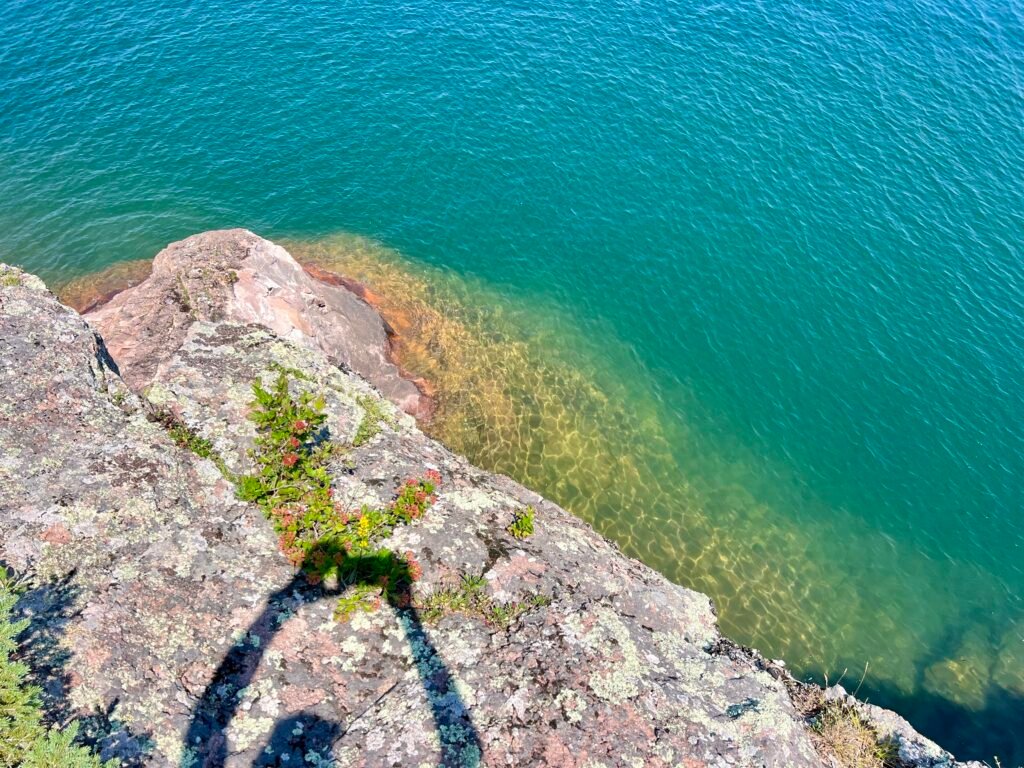
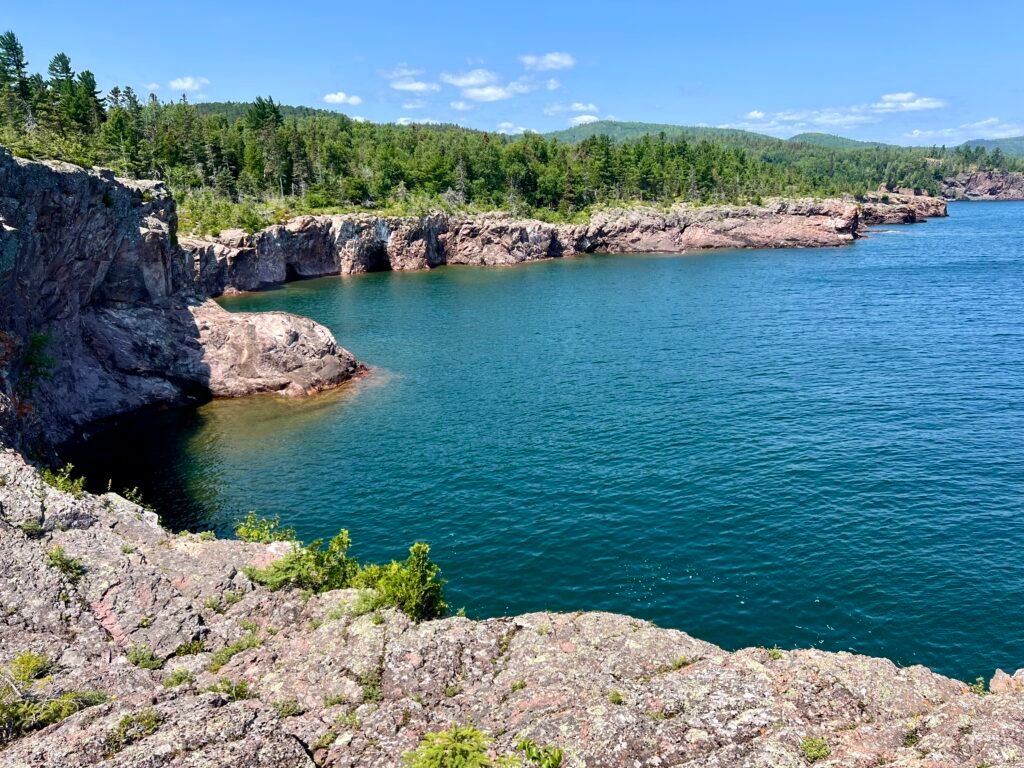
Photos: Lake Superior – Turquoise Water and Incredible Views

At the River Mouth, I climbed onto the rocks and, to my surprise, found myself part of a FaceTime call. Seriously, do we need to share our conversations with the entire world? I quickly made my escape to the rocky beach, where I enjoyed a peaceful moment with a lone seagull. As a group of teens descended with their towels and chatter, I decided I’d had my fill of the park for now and made my exit.

Photos: The River Mouth—Totally Different Feels!
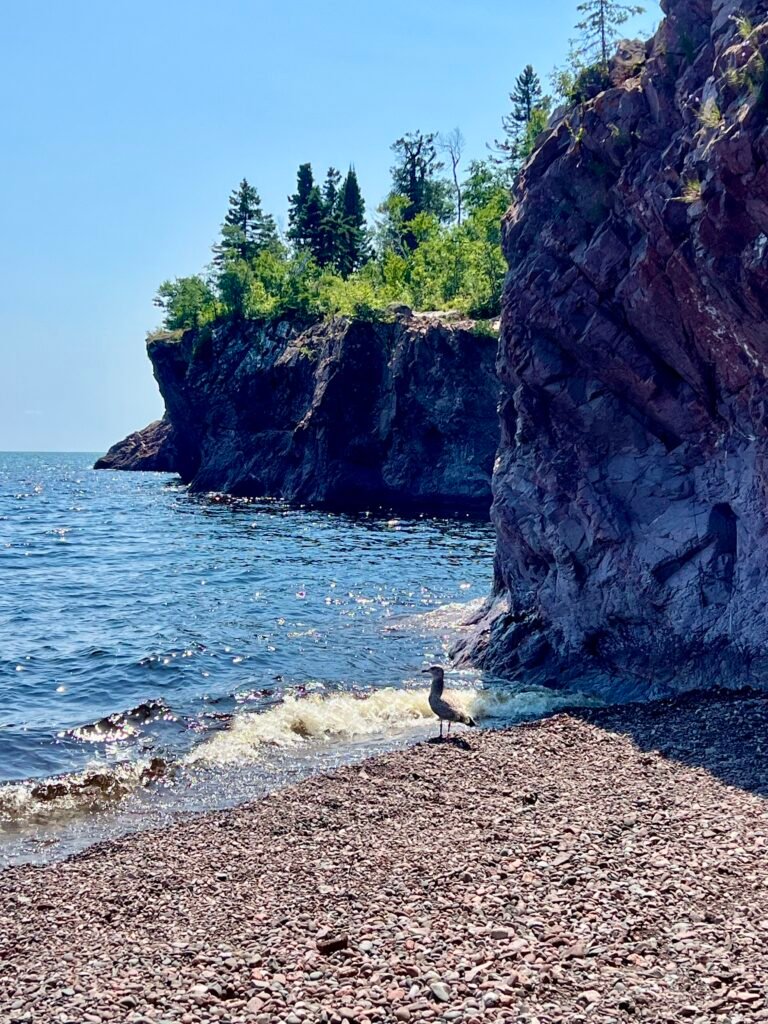
Photos: Chillin’ with a Seagull | The Baptism River—A Much Calmer Day

Palisade Head: Glad for Visit #2

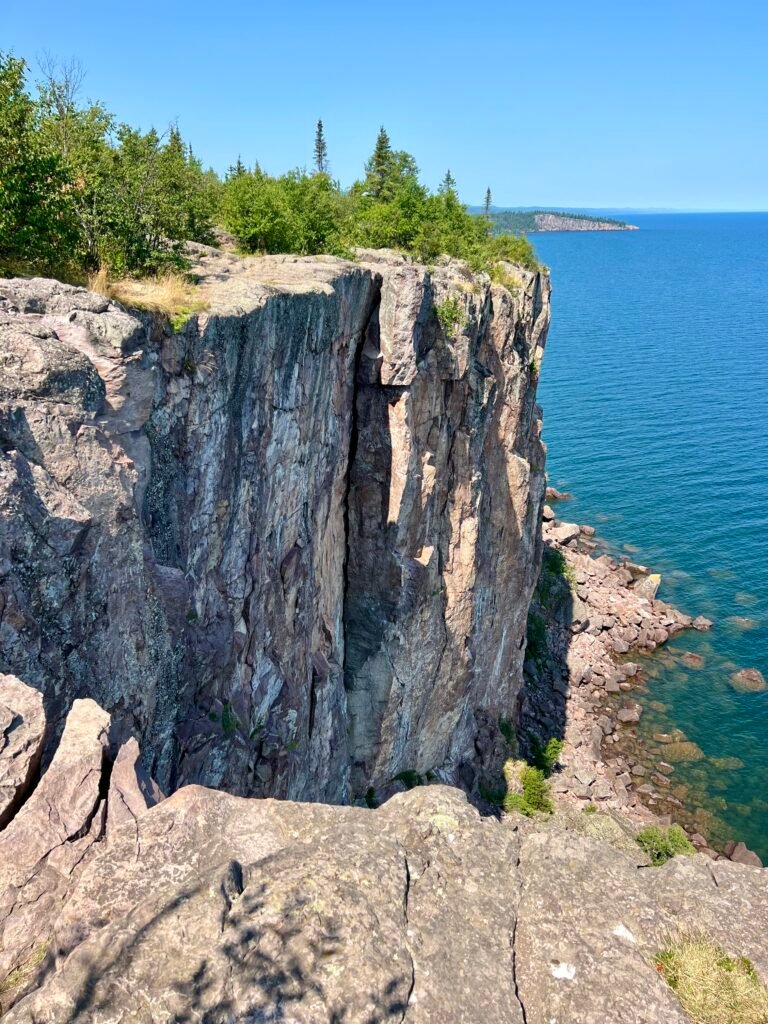
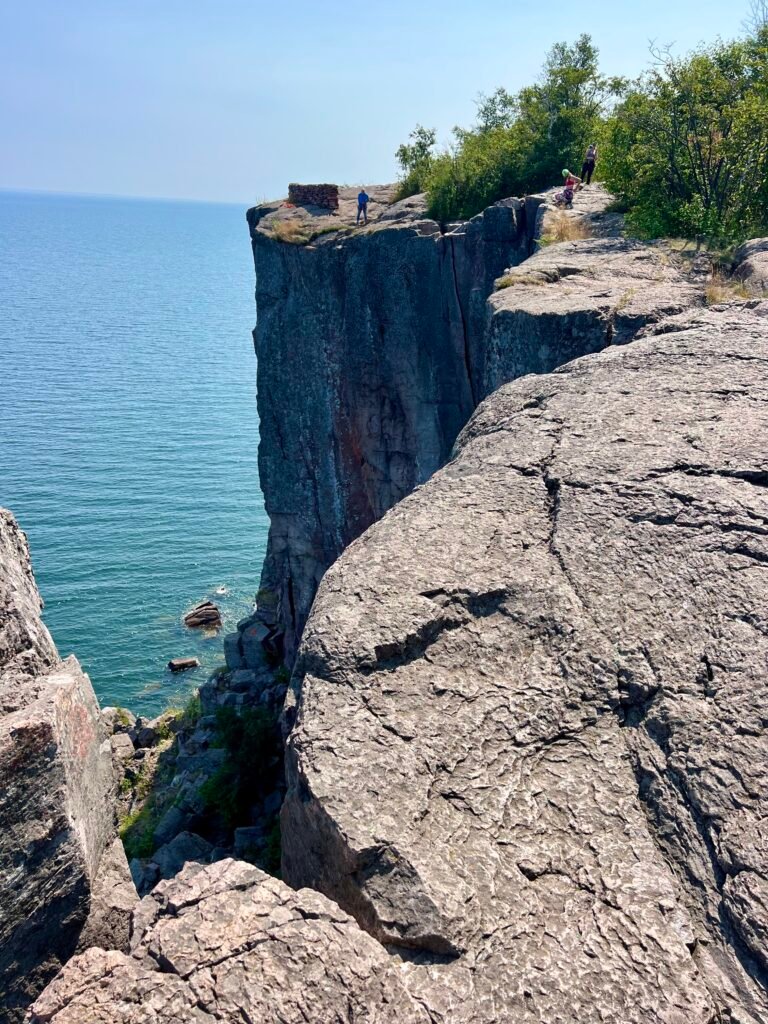
As I drove out of the park on MN-61, I decided to revisit Palisade Head. This time, I drove up to the top. The area was bustling with motorcyclists, cars, and climbers. I walked around more, finally understanding the hype. The cliffs were indeed impressive, especially for climbers. I was glad I made the detour.

Photos: Palisade Head – Views Towards Shovel Point | Climbers Preparing to Conquer Palisade Head

Wrapping Up: Tettegouche State Park, What a Gem!

Who knew that a place I initially knew little about would turn out to be such a treasure? Tettegouche State Park blew my expectations out of the water, leaving me in awe of its rugged beauty and diverse landscapes. This was my first foray into Minnesota’s North Shore, and let me tell you, it definitely won’t be my last. From the thrilling hikes and awe-inspiring waterfalls to the peaceful, misty mornings by the river, Tettegouche has it all. If you haven’t made the trip yet, put it at the top of your list. Trust me, you NEED to experience this hidden gem for yourself.

Two Harbors: Campground Chaos and Sweet Treats

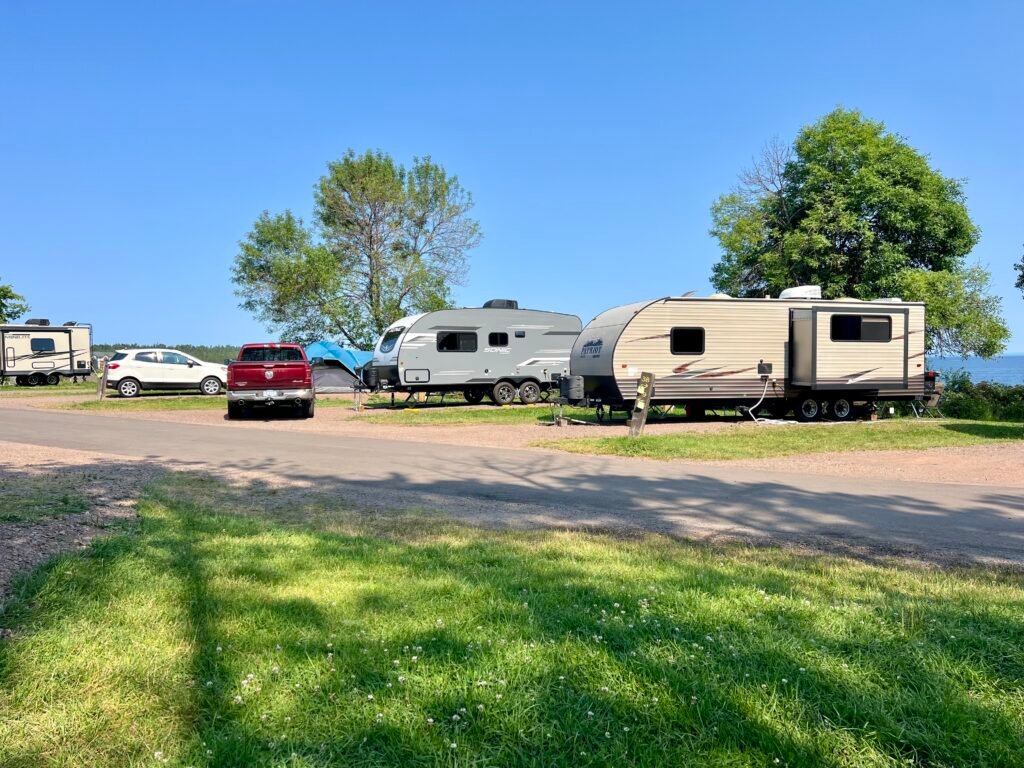
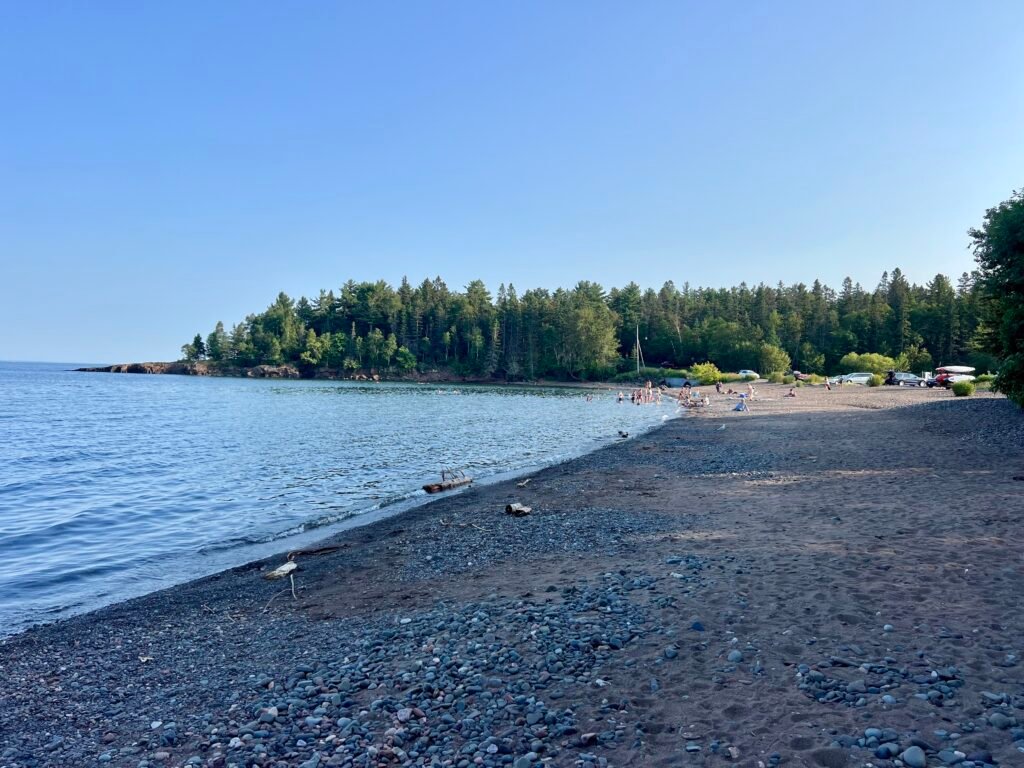
My next stop was Two Harbors, just a 30-minute drive down MN-61. I stayed at the Burlington Bay Campground, which was a stark contrast to Tettegouche—campsites were packed in like sardines, with zero privacy.

Photos: Burlington Bay Campground—Sardine City! | Two Harbors Beach

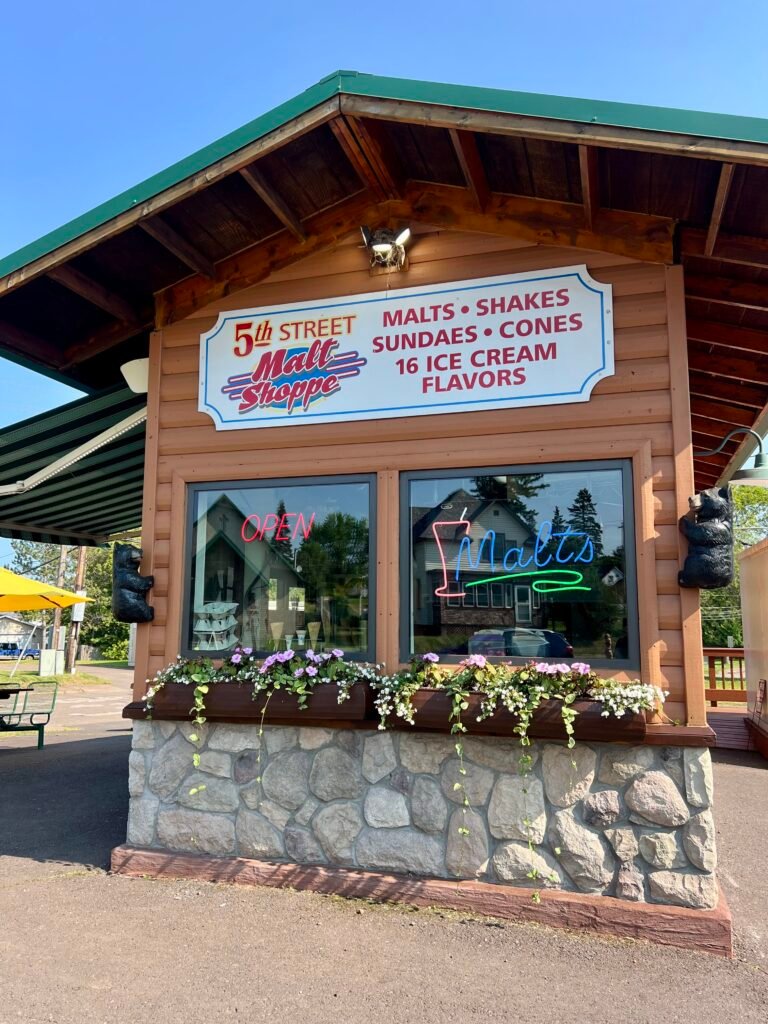
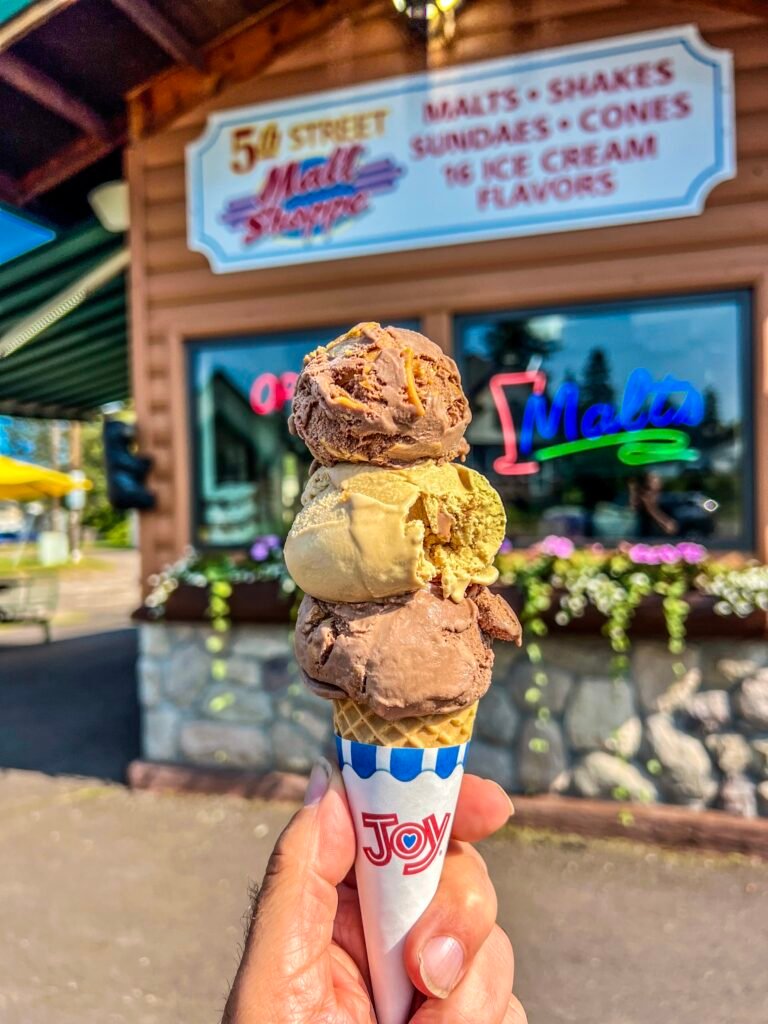
Craving a bit of nostalgia, I made a beeline for the 5th Street Malt Shoppe and treated myself to a scoop of Chocolate Peanut Butter with a side of Coffee Ice Cream. Back at the campground, I wrapped up the day with a glass of red wine on the beach, gearing up for my next adventure in Minneapolis.

Photos: 5th Street Malt Shoppe | My Delicious Reward!

Minneapolis Finds: Kowalski’s and More

In Minneapolis, I had to check out Kowalski’s Grocery, a renowned local chain. It did not disappoint! The pizza was tasty, though a bit light on basil. Definitely worth a visit if you’re in town. I also stopped by Goodwill to donate some camping gear I couldn’t take home—like a folding lounge chair.

Photos: Kowalkski’s in Minneapolis | Impressive Fish Counter!

Photos: Epic Prepared Goods Counter | My Pizza—Could’ve Used More Basil

Finally, I was off to the airport and then to Chicago for an REI class on Backcountry Navigation and Map Reading. Pro tip: Use TSA-approved locks for your luggage. I learned this the hard way when TSA had to cut off my lock due to my hastily purchased one not meeting their standards. Oh well!

Photo: Parting Shot—Oops, Lesson Learned!

And with that little adventure, my month-long trek through the Upper Midwest comes to an end. What a summer to remember!

Photos: A few of the Summer Highlights!

Catch you on the road!

Tettegouche State Park | Minnesota | Part 1

Welcome to the North Shore’s Hidden Gem

Tettegouche State Park, perched along the rugged North Shore of Lake Superior in Minnesota, is more than just a park—it’s a treasure trove of natural beauty, history, and adventure. Spanning nearly 9,400 acres, it boasts six inland lakes, four stunning waterfalls, and 22 miles of hiking trails. Plus, it’s one of just four state parks in Minnesota with rock climbing.  Whether you’re an adrenaline-pumping hiker or climber, an eagle-eyed birdwatcher, or just someone looking to soak in some serious tranquility, Tettegouche has got you covered. And trust me, this place is anything but ordinary.

The Calm Before the Storm: A Pit Stop in Duluth

But before diving into Tettegouche, let me set the scene. My journey began with a stop in Duluth, Minnesota, where I did something as mundane as laundry. Now, doing laundry at a laundromat might not sound like blog-worthy material, but hear me out. It’s in places like these where life unfolds in unexpected ways. At the laundromat, you get a front-row seat to humanity. From the overworked mom juggling kids and detergent to the retiree meticulously folding each shirt, you realize we’re all in this together, one spin cycle at a time. It’s a humbling reminder that no matter where the road takes us, we all have these shared, simple moments. Plus, my timing couldn’t have been better; the skies opened up with a torrential rainstorm, turning this simple chore into the perfect escape.

Afterward, I made my way to a quirky spot for the night: the Lakewalk Parking lot behind the Holiday Stationstore on London Road. My trusty SUV was once again my “tent,” and I rolled in with daylight to spare. I took the chance to stretch my legs on the Lakewalk, enjoying some stunning views of Lake Superior. The trail was buzzing with bikers, runners, and walkers—perfect for a little people-watching.

After dinner and a quick pit stop at the Holiday Stationstore (yes, I grabbed a drink to make using the restroom more legit), I settled in for the night. Not quite used to “roadside camping,” my sleep was a bit fitful. But by sunrise, the morning walkers had me up and at ’em. Clearly, this spot is where Duluthians kick off their day!

Photos: My Roadside Campground in Duluth, Minnesota

The Journey Begins: Coffee, Lighthouses, and Early Morning Solitude

Bright and early the next morning, with a fresh cup of grind-and-brew coffee from the local Holiday Stationstore (bless those machines!), I set off for Tettegouche State Park. But hey, what’s a road trip without a few detours? My first spontaneous stop: Split Rock Lighthouse. Nestled dramatically on a cliff, this lighthouse has been guiding ships since 1910. Although it was too early for the lighthouse to be open (that’s what you get for being an early riser!), I still wandered the trails, soaking in the views of Lake Superior as the morning mist clung to the cliffs.

Photos: Split Rock Lighthouse

Not far from there was Palisade Head, a remote portion of Tettegouche. And yep, you guessed it—I was early again. But being early isn’t all bad; it meant I had the place to myself, which made the ½-mile hike up the road totally worth it. The views were nice, but I knew I’d have to come back to truly do this spot justice.

Photos: History of Palisade Head | Communication Tower on Palisade Head

Photo: Looking east towards Shovel Point

Class is in Session: The Visitor Center Experience

Next stop: the Tettegouche Visitor Center. Even though I arrived before it officially opened, the restrooms were available, and let me tell you, they were more educational than your average pit stop. Imagine this: you’re in the stall, and there’s a poster teaching you how to pronounce “Tettegouche” (it’s Tet-a-goo-sh, in case you’re wondering) and sharing the history behind the park’s name. Who knew a bathroom break could double as a history lesson?

Photos: The Visitor Center | My History Lesson

Once the visitor center opened, I met Bev, a staff member with a wealth of knowledge and a contagious enthusiasm for the park. After chatting with her, I felt like I had the insider’s guide to Tettegouche, and she encouraged me to check out the Shovel Point Trail. But, in true Upper Midwest fashion, she also warned me about the stairs—lots of them. It seems like folks around here have a bit of a thing about stairs, but I wasn’t going to let that scare me off.

Photos: Park Maps and Information

Photos: Campground and Climbing Areas Maps

Shovel Point Trail: Stairway to Heaven

The Shovel Point Trail is a 0.6-mile journey that feels like stepping into another world. Starting at the visitor center, the trail winds along Lake Superior’s shoreline, with rugged cliffs and wooden boardwalks guiding your way. The day was overcast, with winds whipping off the lake, making the scene both dramatic and serene. Along the way, there’s a set of stairs leading down to the pebble-strewn Lake Superior Beach—a perfect spot for a quiet moment with the waves. And when you reach the end of the trail, you’re rewarded with a stunning view of Palisade Head to the west. The best part? I had the End of Shovel Point to myself, which made the experience even more special.

Photos: The Crashing Waves along Lake Superior Beach | Looking Down on Lake Superior Beach

Photo: The Mighty Lake Superior—Tossing Giant Logs Like Toothpicks

Photos: The Boardwalks and Stairs Awaiting Your Adventure

Photo: Looking West towards Palisade Head

Photos: Shovel Point’s Climbing Zone | A View from the Edge

Photos: The End of Shovel Point | Observation Deck with Amazing Views

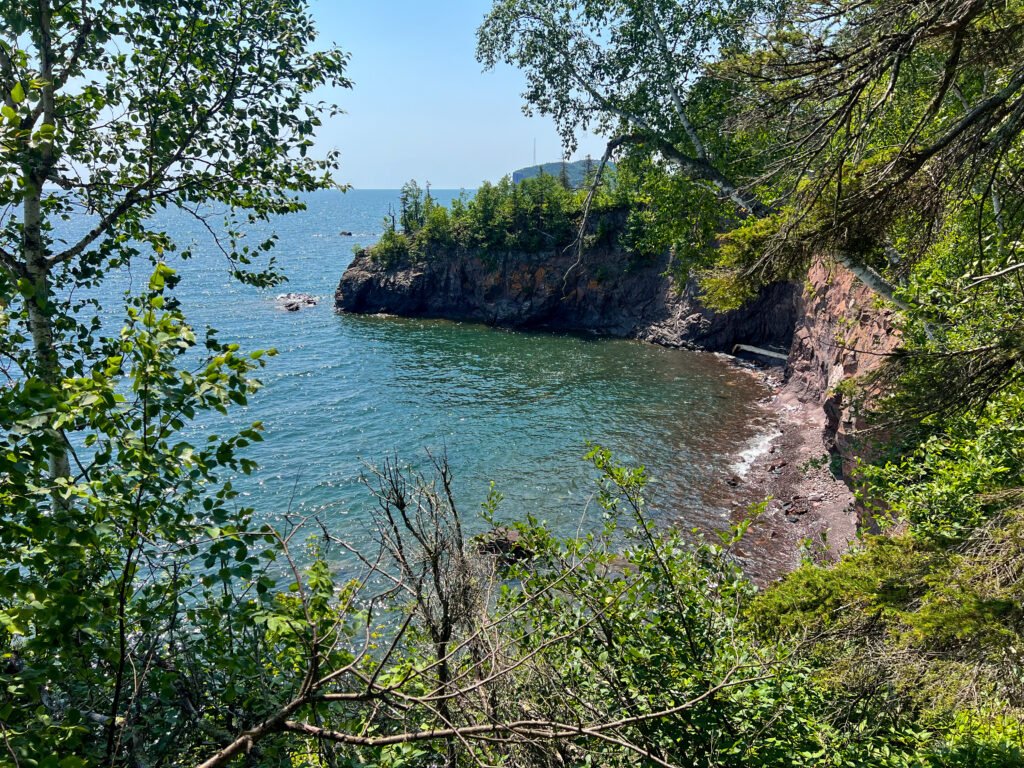
Photo: The Breathtaking Coastline

The Baptism River Mouth: Nature’s Symphony

After Shovel Point, I headed back to the visitor center, then took a short walk to the Baptism River Mouth. Here, the river meets Lake Superior, and it’s like nature’s version of a grand finale—water crashing against rocks, winds whipping through the trees, and the colors of the landscape shifting with the light. This was my first day at Tettegouche, and the weather added an extra layer of wildness to the scene. The river was a churning force, and the waves on the lake were anything but gentle.

Photo: Baptism River Mouth

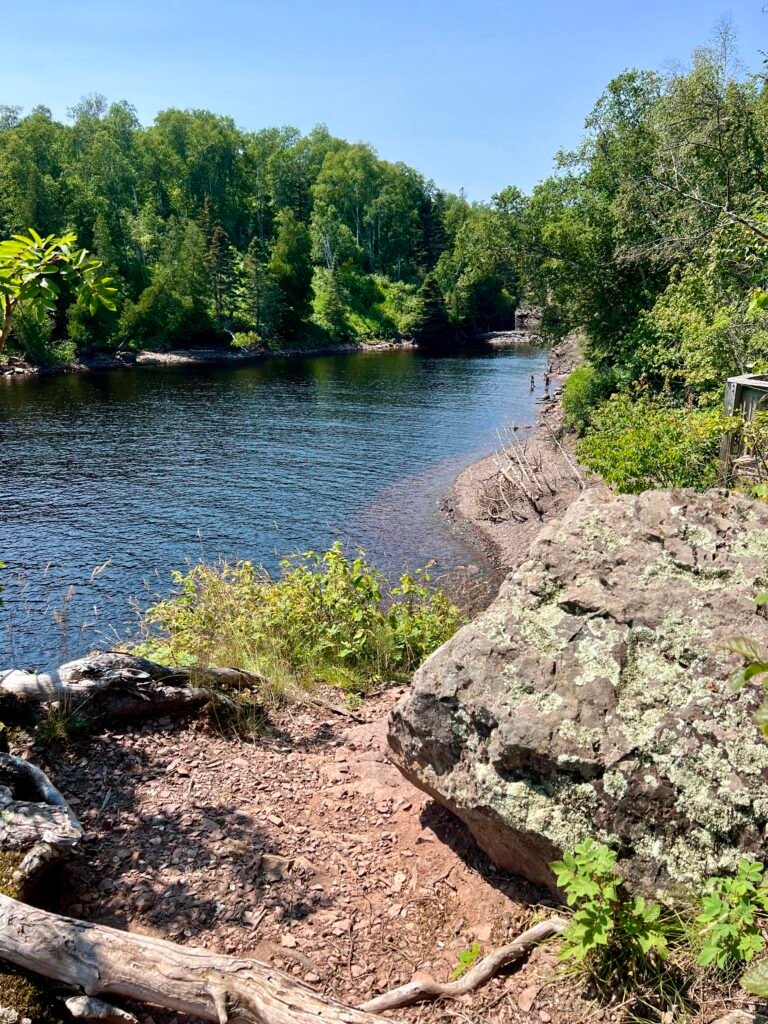
Photos: Looking Up the Baptism River | A View of the River Mouth from the River’s Edge

Connecting the Dots: From Pasty to Passion

Back at the visitor center, I couldn’t resist buying some postcards (I love sending those out from my travels—what can I say, I’m a bit old-school like that). I also had another chat with Bev, who, as it turns out, is from Ishpeming, Michigan—the same town I had driven through the day before. Small world, right? I told her about my pasty experience there, and she asked if I had seen the US Skiing and Snowboarding Hall of Fame. I hadn’t, but I did notice a cool statue of a ski jumper outside. Here’s the kicker: that statue, “Passion to Fly,” is of Bev’s cousin, who was a famous ski jumper! Moral of the story? Put down your phone and engage with the world around you. You never know what connections or stories you might uncover.

Photo: The Statue of Bev’s Cousin at the US Skiing and Snowboarding Hall of Fame

Illgen Falls and Devil’s Rock: Chasing Waterfalls

With the day still young, I decided to explore Illgen Falls. This 40-foot waterfall, located upstream from the High Falls, isn’t accessible from the park’s main trails, but it’s worth the extra effort. The best part? You can get really close to the falls, feeling the cool mist on your face as the water crashes down.

Photos: The Parking Lot off MN-1 | Illgen Falls and Devil’s Rock Trailhead

Photos: View from the Brink of the Falls | Illgen Falls

Photos: Illgen Falls: A Waterfall with Multiple Personalities

Feeling adventurous, I also hiked out to Devil’s Rock. I’ll be honest—it was a little underwhelming, but the hike itself was pleasant, and the mosquitoes were just starting to wake up as the day warmed up. Not to worry, though; a little bug spray kept them at bay.

Photos: Nature’s Quirky Sculpture | Devil’s Rock—Is It Really That Impressive?

A Quick Pit Stop and High Falls Trail

After all that exploring, I took a quick trip into town for some gas, ice, and a postcard stamp run (thanks, Melissa, for the stamps—unfortunately, I didn’t bring enough on this trip). Then, I was back at the park, ready for more adventure. I parked at the High Falls Trailhead, eager to see the highest waterfall completely within Minnesota’s borders.

Photos: High Falls Trailhead | The Trail is a Blend of Boardwalks and Dirt Trails

The trail is 1.5 miles one way and is impressively maintained. You’ll navigate steep sections with wooden stairs, gravel paths, and some bare rock. Along the way, there’s a side trail with 200 steps down to Two Step Falls. It was a bit of an adventure, especially since a storm had wiped out the last set of stairs. The climb down to the river’s edge was a bit sketchy but totally doable!

Photos: The Steep Descent to Two Step Falls | The Section That Took a Dive

Photo: Two Step Falls

At last, the payoff: High Falls, cascading a dramatic 63 feet. The roar of the water and the mist it sends up are nothing short of mesmerizing, providing a refreshing cool-down after the hike.

I knew the trail ahead was closed due to the storm knocking out the swinging bridge (I’ll share some pics in Part 2). Still, I pushed on as far as I could to get as close as possible to the brink of the falls.

Photos: Looking Ahead: Left – The Bottom of High Falls and Right – The Brink and the Swinging Bridge (Well, What’s Left of It!) | Bonus: More Stairs for Extra Fun!

Photo: The 63-foot High Falls

Photos: High Falls Brink | The Closed Trail | Across the River—Where I Was Supposed to Go (But Hey, Adventure Awaits!)

Trail Running and Campsite Life

On the way back to the parking lot, I squeezed in a quick trail run—one of my favorite ways to enjoy the trails. fterward, I checked into my campsite, which involved a bit of a winding drive through the park to the Baptism River Campground. Like at Tahquamenon, the park was buzzing with activity, so I had to juggle campsites each night due to high demand. More on that in Part 2.

I settled into camp, lit a cozy fire, enjoyed a hearty dinner with a couple of cold ones, and hit the sack. It was a big day, and tomorrow promised an even bigger adventure as I geared up to tackle Eagle Mountain, Minnesota’s highest natural point.

Photos: My Campsite for the Night—Where the Magic Happens | Check Out This Epic Fire!

That’s a wrap on Part 1 of my Tettegouche escapade. Stick around for Part 2, where the sun finally shines, the trails beckon, and the park unveils even more of its magical charm. Trust me, you won’t want to miss it.

Catch you on the road!

Dates of Visit: 22 & 23 July 2024

Tahquamenon Falls State Park | Michigan

A Michigan Gem

Nestled in the heart of Michigan’s Upper Peninsula, Tahquamenon Falls State Park is a treasure trove of natural wonders and breathtaking beauty. With nearly 50,000 acres of pristine wilderness, this park is home to one of the most impressive waterfall systems east of the Mississippi, drawing nature enthusiasts, photographers, and adventure seekers alike. Beyond the falls, Tahquamenon Falls State Park boasts over 35 miles of hiking trails that weave through dense forests, scenic overlooks, and along the picturesque Tahquamenon River. So, grab your bug spray, lace up those hiking boots, and let’s dive into my adventure through this U.P. gem!

Pronunciation Tip: Tahquamenon is pronounced tuh-KWAH-muh-non.

The Mighty Tahquamenon Falls

The crown jewels of Tahquamenon Falls State Park are undoubtedly the waterfalls themselves. The park features two main sets of falls: the Upper and Lower Falls. The Upper Falls, often referred to as the “Root Beer Falls” due to their distinctive amber color, are a sight to behold. Spanning 200 feet across and dropping nearly 50 feet, this waterfall is the second largest in volume east of the Mississippi River, only trailing Niagara Falls in size! The unique hue of the water is thanks to tannins leached from the cedar swamps that feed into the river—nature’s very own chemistry experiment. Visiting the Upper Falls offers multiple viewing platforms and trails that allow you to marvel at the roaring waters from various angles.

Photo: The Upper Falls

The Lower Falls offer a more intimate yet equally mesmerizing experience. This series of five smaller cascades encircle an island, accessible by rowboat or a charming footbridge. Exploring the island and the surrounding waters is like stepping into a tranquil escape—perfect for a leisurely day of picnicking, swimming, and photography.

Photo: Two of the Smaller Cascades that make up the Lower Falls

Roadtrips and Sunsets

I arrived in the afternoon, eager to explore. After checking into my campsite at the Rivermouth Campground, I couldn’t resist a quick detour north to Whitefish Point (check out my other post on Road Trippin’: The U.P.) – Great Lakes Shipwreck Museum and the historic Whitefish Point Lighthouse. On the way back to camp, I made a couple of stops that were just too good to pass up.

First, I swung by the Rivermouth Roadside Park, a small but scenic spot on the Lake Superior shoreline. Michigan seems to have a thing for these roadside parks, and honestly, I’m here for it. They’re like little oases for travelers, offering a place to picnic, rest, and soak in the scenery. A short hop down the road brought me to Clark Point Trail. Calling it a trail is a bit generous—it’s more like a quick walk from the parking lot to the lake—but it was fun exploring the shoreline. This spot is also a birdwatcher’s paradise, so bring your binoculars if that’s your thing.

Photos: Views from Rivermouth Roadside Park | And from the Clark Point Trail

Back at camp, I settled in for the evening with a campfire and dinner. But the real treat came later, as I headed to the campground’s beach on the Tahquamenon River. With golden hour approaching, I grabbed a cold one, found a log to perch on, and let nature’s show unfold before me. There’s something magical about watching the sun dip below the horizon while the river flows quietly by—it’s the perfect way to end a full day of adventure.

Photos: My Campsite | The Evening’s Fire

Photos: The Tahquamenon River – great for Kayaking | Enjoying a Cold One!

Photos: Enjoying Nature’s Show | Golden Hour at the Tahquamenon River

Photo: The Perfect Way to End the Day!

No time to wait on late rangers

First, A note to fellow adventurers: Tahquamenon Falls has two main entrances, one at the Upper Falls and the other at the Lower Falls. It’s not uncommon to see long lines, especially in the morning or around 3 PM when campers are checking in.

Photo: Lower Falls Entrance from the Parking Lot | Hard to Get Lost Here!

Photos: Lower Falls Map | Upper Falls Map

Photo: Tahquamenon Falls State Park Map

The next morning, I was up early and ready to hit the trails. My first stop was the Lower Falls. After waiting a bit for the entrance booth to open on time at 8:00 AM (spoiler alert: it didn’t), I decided to get a head start on my day. I wasn’t going to let the rangers late start ruin my plans! Just up from the parking lot, there’s a handy area with bathrooms, the Lower Tahquamenon Falls Café & Gift Shop, and even rowboat rentals for exploring the Tahquamenon River. The hike from the gift shop to the Lower Falls is only a half-mile, mostly on a raised boardwalk. Being early, I had the place almost to myself, save for a few other early risers. Along the way, you’ll spot a wooden plaque featuring the Prayer of the Woods—a reminder to be mindful and respectful of the natural beauty around us.

Photos: Bear Cubs at Play – a sculpture at the entrance | Rowboats for Rent

Photos: The Boardwalk to the Lower Falls | The Prayer of the Woods

The Lower Falls consist of a series of five smaller falls cascading around an island. You can either view them from the riverbank or cross the Ronald A. Olson Island Bridge to explore the island. I’d recommend the latter—it’s a short half-mile loop around the island, and you get to see all five falls up close. Plus, the bridge itself is pretty cool, especially with the river roaring below after the recent rains.

Photos: Ronald A. Olson Island Bridge

Photos: The Island Loop – It’s pretty flat until you hit the boat dock area, where you’ll find a few stairs

Photos: Morning Views from the Island Loop

Photos: A few views of the Cascades at the Lower Falls from the Island

Feeling inspired and ready for a bigger adventure, I changed into my trail runners, grabbed my poles, and lathered myself in bug spray. My next challenge: the 4-mile one-way hike from the Lower Falls to the Upper Falls along the River Trail, known for its scenic beauty, winding through old-growth forests and along the river.

The River Trail: A Hiker’s Delight with Otters

Now, let me give you a heads-up: this trek is not for everyone. It’s got its fair share of exposed roots, hilly terrain, numerous staircases, and was a bit overgrown in some areas. But if you’re up for the challenge, the rewards are more than worth it. At one point, I even stumbled upon a group of river otters frolicking along the riverbank. They didn’t notice me at first, but when I “clicked” to get their attention for a photo, they weren’t too thrilled and quickly disappeared into the water. I guess not everyone is a fan of the paparazzi!

One thing to note is that the trail isn’t always the best marked or maybe I just wasn’t paying attention. I may or may not have taken a wrong turn at one point, but hey, getting lost is part of the adventure, right?

Photos: River Trailhead at the Ronald A. Olson Island Bridge | Time to walk the plank and dodge some roots on the River Trail!

Photos: The River Trail – A fun combo of dirt paths and wooden boardwalks!

Photos: The Otters – Before they knew I was around | And after – when they gave me an earful!

Photos: Check out one of the amazing views of the Tahquamenon River along the trail! | And yep, even on the way up to the Upper Falls, you’ll hit some stairs going down—perfect cardio workout!

Stairmasters and Nature’s Powerhouse

After what felt like a mini-marathon, I reached the Upper Falls. The 181 stairs down to the Gorge View seemed like child’s play after my hike, and the view was nothing short of spectacular. From here I got my first glimpse of this massive cascade with a nearly 50-foot drop and a width of over 200 feet. The sheer volume of water crashing down is mesmerizing—it’s said that during peak flow, over 50,000 gallons of water rush over the falls every second, hence getting the title of the second largest east of the Mississippi.

Photos: Coming off the River Trail and hitting the Upper Falls Viewing Areas | First stop: the Gorge View!

Photos: Stairmaster Workout – 181 stairs down to the Gorge, then back up

Photos: Boardwalk to the Viewing Area | Along the Gorge

Photos: The Upper Falls from the Gorge Viewing Area

If you’re a sucker for scenic spots, the Brink View area is another must-visit. After another 94 steps down, you’ll be rewarded with a front-row seat to one of nature’s most powerful shows. This area was definitely more popular, and I had to navigate around a few selfie-taking tourists, but the view was worth it. After taking in the sights, I headed to the Upper Falls parking lot, a short 0.3-mile walk on a paved walkway. This spot has some nice perks too, like the Tahquamenon Falls Brewery & Pub, Camp 33 Gift Shop, an outdoor picnic area, and even a food truck, though it wasn’t open when I visited.

Photo: The “Root Beer Falls” from the Brink Viewing Area

After all that hiking, I figured I deserved a reward, so I made my way to the Brewery & Pub. Unfortunately, nothing on the menu really caught my eye, but I couldn’t pass up the chance to try one of their beers. I went with the Falls Tannin, an American Red Beer. It had that deep amber hue, just like the Upper Falls, but the taste was… well, just okay. Not exactly something to write home about, but it hit the spot after a long day on the trails.

Photos: Tahquamenon Falls Brewery | Tried the Falls Tannin – does it look like the falls? | Today’s brews!

Trail Running and Campfire Bliss

Rested and refreshed, it was time to head back down the River Trail to the Lower Falls parking lot—a solid 4+ miles back. This time, I took the Nature Trail to the River Trail, the path I had hiked up earlier. Feeling a bit adventurous, I decided to turn the hike into a trail run. The path was getting busier with other hikers, so I had to weave around a few people, but it was a fun way to end the day.

Back at the Lower Falls parking lot, I packed up and headed to my campsite for the night—The Lower Falls Portage Campground. Back at the campsite, I treated myself to a hot shower, made another campfire, and settled in for the night. I had a 7-hour drive to Duluth, Minnesota, ahead of me the next day, so I knew it would be an early night. But as I sat by the fire with a cold drink in hand, I couldn’t help but feel a sense of contentment. Tahquamenon Falls State Park had lived up to every expectation and then some.

A Memorable Adventure

Tahquamenon Falls State Park is more than just a place to visit—it’s a place to experience. Whether you’re marveling at the mighty falls, exploring the serene hiking trails, or simply soaking in the natural beauty, this park offers something for everyone. And if you’re lucky, you might even have a few memorable encounters with the local wildlife. Just don’t forget to pack your bug spray, plan to camp in the park, and get ready for an adventure you won’t soon forget. So, what are you waiting for?

The Pasty Pursuit: A Culinary Quest

As I drove through the U.P., I kept seeing signs for pasties (pronounced pass-tee, not pay-stee.) —what are these mysterious pastry things? As a curious foodie, chef, and restauranteur (also a pescatarian), I had to find out. After some quick research, I found a place in Ishpeming that had a vegetarian option. I headed to Lawry’s Pasty Shop, only to be disappointed—apparently, they don’t cook the vegetarian ones on-site. Determined not to leave empty-handed, I backtracked to Irontown Pasties in the heart of Negaunee. After a bit of a wait (perfect for catching up on Words with Friends), I finally snagged a veggie-cheese pasty. The staff was super friendly, and when I asked about the “proper” way to eat it, they handed me a no-name ketchup bottle and said, “With ketchup!”

My first impression? Well, let’s just say it looked like an Irishman on the beach in Miami—stark white. The dough was a bit undercooked, especially where it was folded. The filling was a mix of broccoli, cauliflower, carrots, onion, potato, cream cheese, cheddar cheese, mozzarella cheese, and spices. It wasn’t horrible, but it wasn’t great either. It was like winning a match by default—you get the victory, but it feels a bit anticlimactic. With that, I headed for Duluth, Minnesota.

Photos: Irontown Pasties | My Veggie-Cheese Pasty – with a side of ketchup, of course!

Catch you on the road!

Dates of Visit: 20 & 21 July 2024

Road Trippin’: The U.P.

Michiganders – Yoopers and Trolls

Meeting a Michigander usually comes with an impromptu geography lesson. They hold their left hand with the palm facing them to represent Michigan’s Upper Peninsula (U.P.), where the Yoopers reside. Their right hand held upright with the palm facing outward, maps out the Lower Peninsula—the area below the Mackinac Bridge, often called “The Mitten” and home to the Trolls. This hand map is a classic and quirky way for Michiganders to show off their state’s geography, which can be charmingly unique or, depending on your perspective, a bit annoying. Now let’s explore the U.P.

Photos: A Michigander Map | A Traditional Map

The Great Lakes’ Greatest Hits

If the Great Lakes had a Greatest Hits album, it would definitely be titled Lighthouses & Waterfalls – these iconic features are everywhere you turn. After leaving L’Anse, I cruised east on US-41 for a scenic hour and fifteen minutes, landing in Marquette, Michigan—the largest city in the U.P. With a population of just under 20,000, Marquette blends small-town charm with big-city amenities. I love to make pit stops during my road trips, so naturally, Marquette called for a quick exploration.

This lakeside town boasts stunning Lake Superior views, and it’s home to Northern Michigan University, which adds a youthful vibe to the area. If you’ve got the time, a hike up Sugarloaf Mountain offers unbeatable vistas, with a panoramic view that stretches for miles—perfect for taking in the sheer scale of Lake Superior, which, by the way, holds enough water to cover North and South America in a foot of water. Or you can take a leisurely stroll along the harbor for some serious photo ops.

One stop you shouldn’t miss is the decommissioned Ore Dock, a towering relic of Marquette’s industrial past. Once a bustling hub for shipping iron ore, this massive structure now stands as a dramatic piece of history along the waterfront. Its rusted, steel frame and vast length make for an impressive sight, and the dock offers a unique perspective on the city’s maritime heritage. I also wandered over to the Marquette Harbor Light Station, only to discover you need to sign up for tours to actually explore the grounds—something to keep in mind if you plan a visit! It was a brief stop, but I’m glad I checked it out.

Check ☑️, saw Marquette.

Photos: The Lake Superior Shoreline | Marquette Harbor Light Station

Photo: The Decommissioned Ore Dock

Next up on my journey, Wagner Falls Scenic Site in Munising, Michigan—a spot that the Wisconsin ladies I met at Starved Rock State Park raved about. If you caught my earlier posts, you’ll remember these ladies also tipped me off about Parfrey’s Glen, which I checked out earlier this month. A quick 50-minute drive and I found myself at the falls.

Photos: The Trailhead | A Glimpse into the Park’s History

Wagner Falls is located just 1.5 miles south of Munising, right off Michigan 94. Parking is available on both sides of the road, and I managed to snag one of the last spots. This little gem is a Michigan State Scenic Site, and the 0.25-mile trail is an easy stroll that takes you through a dense forest of old-growth pine and hemlock trees. The falls themselves are a 20-foot cascade that tumbles over limestone and sandstone—geological formations that are hundreds of millions of years old. Perfect for those Insta-worthy pics. Be prepared, though—the place draws a crowd, including city folk who seem more glued to their phones than the stunning falls in front of them. But don’t let that stop you—Wagner Falls is definitely worth a stop if you’re passing through, though maybe not worth going out of your way for.

Photos: Wagner Creek | Wagner Falls and Scenic Observation Decks

Photo: Wagner Falls

Who Knew?!

I hit the road again, heading west toward Tahquamenon Falls State Park, a scenic hour and a half drive away. The park covers nearly 50,000 acres, making it Michigan’s second-largest state park. My spot for the night was Rivermouth Campground—about 17 miles from the Lower Falls and just 5 miles south of Paradise, Michigan, off Michigan 123. Weekends in the U.P. can get pretty busy, so I had to split my visit between two different campgrounds. But hey, I’m mobile, so no big deal!

Photos: Rivermouth Campground Entrance on Michigan 123 | My Campsite for the Night

With limited hiking options at Rivermouth, I decided to venture out to Whitefish Point. Even though I arrived just after the museum and lighthouse had closed, I was thrilled to still have the chance to explore the grounds and beach. Whitefish Point is home to the Great Lakes Shipwreck Museum and the historic Whitefish Point Lighthouse—both perfect for a dose of maritime history. The museum’s exhibits on the infamous Edmund Fitzgerald are as fascinating as they are chilling, featuring haunting artifacts from the shipwreck, including the ship’s bell, which was recovered in 1995. Climbing the lighthouse offers breathtaking views of Lake Superior, and the beach is a treasure trove of driftwood and shipwreck debris. Did you know this area is considered the Graveyard of the Great Lakes? With over 240 shipwrecks in the Whitefish Point area alone since 1816, it’s a must-see for anyone fascinated by Great Lakes lore or simply looking for a memorable stop! Who knew I’d stumble upon such a cool place?

Photos: The Whitefish Point Light Station | An Iron Winch on the Museum grounds

Photos: Rudder from the M.M. Drake | History of the Graveyard of Lake Superior

Photos: Driftwood on the Beach | The Sandy Beach at Whitefish Point

Radio Flashback to 1976!

The Edmund Fitzgerald, a massive freighter that met its tragic end in a fierce 1975 storm, remains one of the most haunting maritime mysteries. Gordon Lightfoot’s classic “The Wreck of the Edmund Fitzgerald” immortalizes the ship’s story with evocative lyrics and a soulful melody, paying tribute to the 29 crew members who lost their lives that night. Standing on that beach, gazing out at the vast expanse of Lake Superior, it felt like being at the ocean—and realizing this was the area where the Edmund Fitzgerald sank was truly awe-inspiring.

Photos: Gordon Lightfoot’s Album | The Edmund Fitzgerald
Photo: Edmund Fitzgerald Memorial

Why Not?

In the end, being spontaneous is what makes any road trip truly memorable. It’s those detours, the unplanned stops, and the little side adventures that often turn out to be the highlights of the journey. You never know what hidden gems you’ll stumble upon, like a lighthouse you didn’t plan to visit or a waterfall tucked away just off the road. And let’s be honest—you might not find yourself back in these parts anytime soon, so why not seize the moment and explore? It’s all part of the adventure, and sometimes, the best stories come from the places you didn’t even know you’d find. So next time, just go for it—you might just discover something amazing.

Catch you on the road!

Date of Visits: 20 July 2024

Road Trippin’ – Iowa to North Dakota

After a grueling climb to the summit of Hawkeye Point, Iowa’s highest natural peak, I was ready to hit the road for South Dakota. I was uber excited because this trip would tick off South Dakota from my list, bringing my total to 46 states visited—eight of which I’ve called home. (Truthfully, I might have hit 48 states—I think I might have been to Wyoming and Montana at some point, but I can’t quite remember, so I won’t count them.)

Mosquito Swarms and Flood-Free Comfort

Let’s dive into my overnight adventure. I decided to camp and booked a site through Hipcamp at The Retreat at Pointers Ridge—a charming spot that offers one campsite amidst its artist retreat. It’s a haven for creativity, where you can do everything from painting to poetry readings, and even dog scent trials. Little did I know, I was in for quite the experience. The host, Deb, was a gem—so accommodating and attentive to my needs. She gave me flawless directions to the campsite and made sure I knew I could just set up and camp.

When I arrived, I checked out the riverbank where my site was set up. As you might remember from my previous posts, I planned to sleep in the back of my rental SUV rather than pitching a tent. While getting settled, Deb popped by to show me around. First thing I noticed: mosquitoes were out in full force—no way was I lighting a fire or hanging out outside, despite the layers of bug spray I slathered on. The second thing: the area had seen a ton of rain, leading to some serious flooding. My campsite was right on the banks of the Big Sioux River, which was pretty high.

Pictures: My Campsite | The swollen Big Sioux River

Deb walked me through the property and mentioned that I was the only guest that night. The property’s centerpiece is a large communal building with a bathroom, shower, electricity, Wi-Fi, and a spacious kitchen and living area. There’s also a small screened-in cottage I dubbed The Bar, complete with lounge chairs and a small bar—perfect for hanging out if the mosquitoes weren’t so relentless.

Pictures: The Main Building and Kitchen

Pictures: Men’s Bathroom and Shower

With more rain on the way and the bug situation being what it was, Deb suggested parking my SUV by The Bar and that I could sleep in my SUV, The Bar, or the main building. I was a bit concerned about potential flooding, but Deb assured me that even during the worst rains, this area stayed dry.

Pictures: “The Bar” and my rental SUV | Some of the cabins on the property

I spent a bit of time in The Bar, but with one door that didn’t quite close and a buggy, humid atmosphere, I decided to crash in the main building. The air-conditioned comfort and cozy couch made for a much better stay—until I woke up in the middle of the night!

Rain, Rain and more Rain!

Here’s where the fun really started. I woke up to a torrential downpour and decided to play it safe by packing up all my gear and stashing it by the door. With my car just 20 feet away, I figured if the river decided to crash its banks, I’d be ready for a quick getaway. I even ventured out to check if the land was turning into a water park or if the river had managed to sneak over its banks.

During a brief lull in the rain, I managed to get some stuff into the SUV. Sleep was elusive that night—flooding fears will do that to you. I was grateful for the cozy refuge of the main building. By morning, with the river still behaving itself, I showered, grabbed breakfast, and hit the road for my next adventure: Devil’s Gulch in Garretson, South Dakota. This quirky spot, highly recommended by Emily, the schoolteacher I met at Hawkeye Point, was conveniently on my route. I figured, why not? After all, you only live once, and a bit of spontaneous exploration never hurt anyone!

Barney Fife Sighting!

As I entered Garretson, South Dakota, the speed limit dropped pretty quickly and when I came over a small hill, there he was – Barney Fife! (I am sure most of you reading this will have to look up who Barney Fife was). Anyway, I was fortunate that I didn’t know where I was going, so I was driving super slow, so no ticket here. But come on Barney, why here? and why so early? Are there that many speeders in the metropolis of Garretson? Or maybe you’re still waiting for Jesse James?

Anyway, if you find yourself cruising through the quiet little town of Garretson, South Dakota, you might stumble upon a place that makes you wonder if you’ve accidentally wandered onto the set of an old Western movie. Welcome to Devil’s Gulch, where history and folklore collide in one of those “blink, and you’ll miss it” attractions that’s more charmingly quirky than downright terrifying.

The Outlaw Jesse James

So what’s the big deal about Devil’s Gulch? Well, legend has it that this narrow, rocky ravine is the very spot where notorious outlaw Jesse James made a daring escape on horseback after a failed bank robbery in Northfield, Minnesota. Now, the story goes that ol’ Jesse was being chased by an angry posse and, in a feat that would make any stuntman jealous, he spurred his horse to leap over the 20-foot-wide chasm to safety. Sure, it sounds a little far-fetched, but who are we to ruin a good story?

Today, visitors can stand at the edge of the gulch, peering down into the murky waters below, and wonder how on earth anyone – let alone a horse – could have made that jump. The truth? Well, it’s probably not quite as dramatic as the legend, but where’s the fun in that? So, if you’re in the mood for a roadside stop with a dash of tall tale and a sprinkle of “this place is just weird enough to be interesting,” Devil’s Gulch is the place for you.

I arrived just as the park was opening, and was immediately greeted by my own posse – that is by a posse of mosquitos. To avoid being eaten alive, like Clark Kent turning into Superman, I quickly suited up for my hike through the park, complete with – yes, you guessed it – copious amounts of bug spray.

Pictures: Trail Information | Trail Map| Trailhead and Donation Box to the right

The park isn’t huge, with ten site markers to discover, although I think I missed a few—probably while swatting mosquitos. The footbridge at the trailhead marks the spot where, in 1876, Jesse James supposedly coaxed his horse to jump the gulch. The open-grill metal bridge gives you a cool perspective on the impressive feat and a hint of what would happen if you didn’t make it across!

Pictures: The Spot where Jesse James jumped the Gulch | View from the River below (Marker #2)

Picture: View from the Bridge | Heading down to Marker #2

Once across the bridge, you’ll want to look for Marker #1: the Cedar Observation Point. Fun fact: Cedar trees are the only evergreen native to South Dakota. I’m pretty sure I saw this, just not the marker. Onward to Marker #2: River Observation Point. From here, you can look back up to the trailhead and get a sense of how high the jump was. You’ll also notice how the rock appears to be “stacked blocks,” one of the Gulch’s many mysteries.

Next up is Marker #3: Towering Rock. I took three pictures in the area, but honestly, I couldn’t tell you which one is Towering Rock. Oh well. Marker #4, another elusive one, is the Scenic Overlook, although I stumbled upon many scenic overlooks.

Pictures: The “Stacked Rocks” appearance of the Gulch walls | Towering Rock? (Marker #3)

Marker #5 is the Cobblestone Path—this one was pretty clear, as you can see in the pictures. As you hike along the rim overlooking the river, you’ll come upon Marker #6: the Waterfall Observation Point. This gives you a great view of the waterfall, which is fed by an underground spring at the top of the falls. Rounding the bend and crossing the next bridge, you’ll find yourself at The Devil’s Stairway/Kitchen—Marker #7. I never did spot the actual marker, but I knew I was in the right place. I decided to descend the stairway a bit. It’s pretty cool how the edges of the right wall are sharp, while the left wall is smooth—another mystery of the Gulch.

Pictures: Cobblestone Path (Marker #5) | Waterfall Observation Point (Marker #6)

Pictures: Devil’s Stairway/Kitchen (Marker #7) | Bridger over Devil’s Stairway

After crossing the bridge, Marker #8 is the Plateau Observation Point, offering a different view of the Gulch and the famous Sioux Quartzite rock. Soon, you’ll cross the last bridge—Devil’s Falls Cross Bridge, Marker #9. Yet another site where I couldn’t find the marker. Once across, you’ll see Marker #10, the Exit—pretty hard to miss. The exit leads you to the Visitor Center, which wasn’t open during my visit, and then to the parking lot.

Pictures: Devil’s Falls Cross Bridge | The Falls from the Bridge | The Gulch from the Bridge

Pictures: Marker #10 – The Exit and a sample of the Markers | The Visitor Center

And that, my friends, is the curious charm of Devil’s Gulch—where the legends are larger than life, the scenery is pretty cool, and the mosquitos are just as relentless (at least when I was there). So, if you’re up for a quirky detour with a side of tall tales, this is your kind of spot.

From Quirky Attraction to a Sacred Site

A mere 30-minute drive from Devil’s Gulch brings you to Pipestone National Monument in Pipestone, Minnesota—thanks to another great tip from Emily, the school teacher. She mentioned a cool waterfall, but little did I know the depth of spiritual significance that awaited me. When I arrived, I found myself alongside a group of old car enthusiasts, their classic cars adding an unexpected touch of nostalgia to the experience.

Pictures: The Visitor Center | A bonus for the visit—Classic Cars

This isn’t just any park. For over 3,000 years, Indigenous people have quarried the red stone here to craft pipes, or “calumets,” used in prayer and ceremony—a tradition still vibrant today. With its profound spiritual and cultural heritage, a visit to the visitor center is a must. There, you’ll dive into the site’s rich history through engaging exhibits and live demonstrations, including artists showcasing their craft.

Picture: Trail Map

As you step onto the Circle Trail—a 3/4-mile paved path—you’ll be immersed in the sacred landscape. Although flooding closed the bridge under the waterfall during my visit, the trail’s short length still allowed for an enriching experience. The rustling prairie grasses and pinkish-red cliffs create a tangible link to the generations who have revered this land long before Minnesota was a state.

The trail leads you past the Spotted Quarry, named for the distinctive appearance of the pipestone. You’ll also encounter Lake Hiawatha, a surprising gem in the middle of the prairie, created by the CCC-ID in the 1930s. As you approach Winnewissa Falls, the smooth sumac—green in summer but brilliant red in fall—adds a splash of color to the landscape.

Pictures: Spotted Quarry | Lake Hiawatha

Pictures: The creek flowing from the falls to Lake Hiawatha | My first glimpse of Winnewissa Falls

Around the falls, you’ll find sites like Old Stone Face and Glacial Ripples, along with the Nicollet Inscription, left by the French scientist Joseph Nicollet in 1838. Leaping Rock, where warriors demonstrated their bravery by jumping from the cliff onto the top of Leaping Rock roughly 12 feet away and jamming an arrow into one of the cracks.

Pictures: Nicollet Inscription | Leaping Rock

Winnewissa Falls, while not the most dramatic waterfall, holds a legendary tale. According to lore, the Great Spirit used the pipestone to form a pipe and smoke it over warring nations, urging them to lay down their arms. The nearby waterfall symbolically pours from the rock, representing peace.

Pictures: The best view I could capture of the falls with the bridge closed—From the Top | The stairs that connect the top and bottom of Winnewissa Falls

Picture: A close-up shot of Winnewissa Falls

Returning to the Visitor Center and completing the Circle Trail, you’ll be greeted by the impressive Quartzite Cliffs and resilient plants thriving through rock cracks. Finally, you’ll reach The Oracle, a natural rock formation with a face-like profile that seems to watch over the land—a sacred spot where offerings were traditionally made in exchange for wisdom.

Picture: Another Quarry Site

Visiting Pipestone National Monument offers a unique journey through both natural beauty and deep spiritual significance. The sacred landscape, with its historical and cultural richness, provides a profound connection to the past. It’s a reminder that every rock and trail tells a story that transcends time, making it a must-see for anyone seeking more than just a scenic view.

Next up: Fort Ransom State Park in North Dakota. Catch You on the Road!

Parfrey’s Glen State Natural Area | Wisconsin

Chatty Cathy

During a visit to Starved Rock State Park in Illinois, I struck up a conversation with a lively group of women on a girls’ trip from Wisconsin. They were seasoned adventurers, always seeking new outdoor escapades. Naturally, I offered to snap their picture, and in return, they shared a treasure trove of must-visit spots. One gem that caught my ear was Parfrey’s Glen State Natural Area. Imagine my surprise when I discovered that this secluded natural wonder is actually nestled within Wisconsin’s Devil’s Lake State Park, which happens to be my next destination—hailed as the best state park in Wisconsin by the Discoverer Blog.

Pictures: Entrance Sign off of County Road DL | Parking Lot

Helpful Hints

Wisconsin charges for entry to its state parks, and Devil’s Lake is one of the pricier ones at $16 per day for non-residents. However, you can snag an annual pass for $38, which is a better deal if you’re planning a longer stay. The only catch? The pass has to be attached to the inside of your windshield. Even though I was in a rental, I opted for the annual pass since I was staying for three days—$48 for daily fees versus $38 for the pass? No brainer!

Now, as you’re planning your visit, I wouldn’t recommend paying $16 just to see Parfrey’s Glen. It’s a nice spot, but not worth the fee on its own. If you’re visiting other parks in Wisconsin, it’s a great addition to your trip.

A Glimpse into History

Parfreys Glen, named after Robert Parfrey, a 19th-century settler who was among the first to appreciate its beauty, has long been a cherished destination for nature enthusiasts. The glen’s formation dates back to the last Ice Age, over 12,000 years ago, when glacial meltwater carved through the sandstone and quartzite, creating the narrow, steep-sided gorge that we see today. This geological marvel not only showcases stunning rock formations but also serves as a living testament to the Earth’s dynamic history. As Wisconsin’s first designated State Natural Area, this enchanting gorge offers a fascinating blend of history, adventure, and breathtaking scenery.

Pictures: Rock Rededicating the Park as a Natural Area

Peaceful Morning Hike

I spent the night in Middleton, Wisconsin (just outside Madison) and woke up early, ready for an adventure. Since I was ahead of schedule, I decided to check out Parfrey’s Glen for a morning hike. The trail is a manageable 1.7 miles round trip, perfect for a peaceful start to the day. The cool morning air and last night’s rain kept the bugs at bay, though they were starting to stir.

Parfrey’s Glen offers a relatively easy yet incredibly rewarding trail that takes you deep into a stunning gorge. The hike begins with a gentle stroll through lush woodlands, then gradually becomes more rugged as you get closer to the glen. Along the way, you’ll cross a creek multiple times and be surrounded by towering cliffs and vibrant, moss-covered boulders. The trail ends at a beautiful waterfall, where the soothing sound of cascading water invites you to pause, reflect, and enjoy the tranquil scenery.

My morning hike at Parfrey’s Glen was the perfect start to an adventurous day in Wisconsin!

Pictures: An Old Pitcher Pump | Trailhead Marker | Initial Part of the Trail

Pictures: Views along the hike

Pictures: The trail and one of the areas you cross the creek

Pictures: The beautiful walls of the gorge

Pictures: Close up view of the gorge walls

Picture: The waterfall at the end of the trail

Pictures: As I finished my hike, I saw a deer | The Ice Age Trail goes into Devil’s Lake State Park

Date of Visit: 7 July 2024

Natural Bridge State Park | VA

An Intro for those Jeopardy! Players

Natural Bridge in Virginia is a geological marvel, standing at 215 feet high and 90 feet wide, carved by Cedar Creek. This natural limestone arch was considered sacred by the Monacan Indian Nation. George Washington surveyed the bridge for Lord Fairfax in 1750. Legend has it that Washington carved his initials into the rock, which visitors can still see today. Oh George, defacing our natural resources? 🤦‍♂️ Maybe the story about him chopping down his father’s Cherry Tree wasn’t a myth? In 1774, Thomas Jefferson purchased the bridge and 157 surrounding acres for 20 shillings, about £1 or $4.44 or roughly $7,200 today with inflation. Quite a steal for the bridge! The site also boasts rich biodiversity, with rare plants and wildlife. Natural Bridge became a National Historic Landmark in 1998, reflecting its historical and cultural significance.

Picture: The Natural Bridge

Camping Adventures

The night before my park visit, I stumbled upon Thunder BRidge Campground, a gem I found on HipCamp. This 100-acre site has quite a history—originally built by the Civilian Conservation Corps in the ’30s, then a boys’ juvenile detention center and a Big Brothers/Big Sisters camp until 2009. Thunder Bridge offers private tent sites, cozy cabins in the woods, and spacious RV spots on a well-kept green space. The host, Adam, was uber friendly, super chill and helpful.

I met Adam at the entrance and arranged to buy some firewood from him. Note: Always buy local firewood to avoid spreading invasive species—many parks ban non-local wood. Adam drove me to my cabin, Woodpecker 1, and dropped off the wood. I chose a cabin because it wasn’t much more expensive, and I didn’t want to hassle with setting up a tent for just one night. The cabin was spacious, had all I needed, and the bathhouse wasn’t far away, complete with a communal room to charge my phone and laptop.

Pictures: Woodpecker #1

Hungry upon arrival, I used some farm-fresh eggs from my previous Airbnb host to make a delicious egg sandwich. Later, I steamed tamales I’d picked up during my travels. Who says you can’t eat well while camping? It was a chilly night in early October, but I survived and enjoyed the adventure!

Pictures: My Egg Sandwich | Cooking Tamales over the Fire

Pictures: My campsite with the wood from Adam | I love making campfires!

Not All Natural Bridges Are Created Equal

A few months back, I had an amazing time at Kentucky’s Natural Bridge, so I was super pumped to check out Virginia’s version. Spoiler alert: it didn’t quite live up to the hype. Sometimes, beautiful spots get too popular and end up feeling more like theme parks than natural wonders, and that was definitely the vibe here. Let’s just say, Virginia’s Natural Bridge won’t be making my list of favorite state parks.

Pictures: The Visitor Center | LOVE sculpture next to the Visitor Center

First off, the entrance fee. If you’ve read my other posts, you know how I feel about high entrance fees. Sure, parks need money for upkeep, but charging $9 per person (13 and over) can make it pretty pricey for families, especially those on a budget. It gave me flashbacks to the pricey Flume Gorge in New Hampshire.

At the Visitor Center, you’ll find the usual suspects: a gift shop, exhibits, and restrooms. From there, it’s a trek down 137 steps to the Cedar Creek Trail. There are a few other trails in the park, but Cedar Creek Trail is the main event. It’s a fairly easy 2.0-mile round trip with a 400-foot elevation change—most of which is tackled by those stairs down to the Trail Store, where you pay your $9 fee at a small window.

Pictures: The start of the walk down to the Trail Store

Picture: Trail Map

A short walk from the store brings you to the Natural Bridge. It’s a cool geological formation, carved over millennia, but it didn’t quite wow me like Kentucky’s. And here’s where things get a bit theme park-ish: rows of benches and spotlights facing the bridge. For almost a century, the bridge has been illuminated on the last Saturday night of every month from April to October. They recreate the first light show from 1927, with the 200-foot-tall arch lit from above and below while Cedar Creek murmurs below. Sounds kind of magical, right? But still, at $9 a pop, it feels a bit commercial.

Pictures: The Natural Bridge – complete with a spotlight in the foreground | Natural Bridge from the other side – notice all the benches at the end of the trail

A Journey Through Time

Walking along Cedar Creek Trail at Natural Bridge State Park in Virginia is like stepping back in time. The trail offers a glimpse into the rich history of the Monacan Indian Nation through its living history exhibit, although it was closed during my visit. This exhibit usually showcases the Monacan way of life, offering insights into their daily activities, traditions, and skills. But based on the pictures, needs a little work.

Pictures: The Monacan Indian Exhibit

Continuing along the trail, you’ll encounter the Saltpeter Cave, a significant historical site used during the War of 1812 for mining saltpeter, a key ingredient in gunpowder. Cool history, but not much to it. Next, you’ll reach Lace Falls, a 30-foot waterfall that provides a serene and picturesque stop. It was nice, but wouldn’t hit my top 100 waterfalls that I have seen.

Pictures: The Saltpeter Cave

Pictures: Views along Cedar Creek Trail

Pictures: Cool Rock on the Trail | Asters or Symphyotrichum

Picture: Lace Falls

Lastly, the trail features the mysterious “Lost River,” which disappears underground, adding an element of natural wonder to your hike. Each of these sites along Cedar Creek Trail tells a unique story, weaving together the area’s cultural and natural heritage.

Pictures: The “Lost River”

I finished my visit back at the Visitor Center to buy some postcards and use the restroom. And since I was there, I decided head downstairs and check out the exhibits. The staff was super cool and showed me the star of the exhibits, a beautiful Eastern Indigo Snake, by the name of Margarita.

Picture: Margarita

Bookend Adventures: The Acorn Inn

Outside of Margarita and yes, the actual Naturall bridge, the hightlights of this trip were camping the night before and then my stay afterwards. Venturing northeast along the Blueridge Parkway from Natural Bridge State Park, I landed in the quaint hills of Faber, Virginia, at the Acorn Inn Bed & Breakfast, about an hour and a half away.

Picture: The Acorn Inn Bed & Breakfast

Nestled amidst the charming hills, Martin and Kathy run this delightful retreat with warmth and flair. Surrounded by lush forests and vineyards, the inn offers a serene escape. Each morning, Kathy’s homemade breakfasts tantalized my taste buds, while Martin brewed some coffee and shared stories and local tips. Turns out, Kathy’s brother shared my college alma mater and major—a small world indeed!

Picture: My Room at the Acorn Inn

Pictures: The Hallway – look at how wide the “stable” doors are! | Communal Men’s Bathroom

Pictures: Communal Living Room | Kitchen (FYI – not set up for cooking) | Banquet Room

Pictures: Outdoor Spaces

With the whole inn to myself for three nights, I soaked in the tranquility. My photos capture the cozy common areas and perfect porch relaxation spots, showing the charm and character oozing from every corner of the inn. How cool is it that the inn was once a stable, transformed by Martin himself? Martin’s craftsmanship is just the start—Kathy’s talent as an artist and photographer shines through the beautiful pieces adorning the walls. I wanted to buy so many of her art pieces! Before opening the Acorn Inn, they lived and worked in Mexico and South America, so the walls are also adorned with folk art, masks, and tapestries from their travels. It’s the perfect spot for remote work and nearby adventures, like exploring the charming town of Nellysford. I couldn’t resist grabbing wine and snacks from Basic Necessities. If you’re in the area, do yourself a favor and check out the Acorn Inn Bed & Breakfast! You won’t regret it.

Pictures: Some of Kathy’s Artwork

Pictures: Some of the Folkart from their Travels & Life in Mexico and South America

Picture: Basic Necessities in Nellsyford | VA

Wrapping Up the Adventure!

As we wrap up this adventure, let’s take a moment to reflect on the highs and lows, the triumphs and tribulations. While Natural Bridge State Park didn’t quite knock my socks off like we hoped (cue sad trombone), my journey wasn’t all doom and gloom. Oh no, my friends, Thunder BRidge Campground was an uber cool find and nestled in the hills of Faber, Virginia, lies a hidden gem—the Acorn Inn Bed & Breakfast, run by the dynamic duo, Martin and Kathy. After all, life’s too short for boring adventures! 🌟

Dates of Visit: 7-12 October 2023

John Boyd Thatcher State Park | NY

I was in the Albany, New York area visiting family, and my sister, Vicki, and I decided to do a hike before we both headed back our separate ways. On a side note, I convinced Vicki to hike Mount Greylock, the highest point in Massachusetts and the first of my State High Points, during a trip to Massachusetts to see the incredible Sona Jobarteh in concert. The two of us have hiked many places together and this hike in John Boyd Thatcher State Park – commonly known as Thatcher State Park – was quite a fun and interesting find.

Brunch First, then Hiking

Our sister Melissa and her husband Richard also made the trip up to Albany as it was sort of a mini family reunion, actually a cousins reunion. After the reunion, and before we headed out, we went to The Scene Coffee and Cocktails in Albany, New York for brunch. It’s a super cute restaurant with a patio, complete with a Gelato Cart (although it was not open when we were there) and a Champagne Vending Machine. I thought the vending machine was super cool. You ordered and paid for everything at the counter, and if you ordered champagne, they gave you a special token for the vending machine. Unfortunately, no champagne today as we were heading out for a nice hike. The brunch sandwiches and coffee were delish and I would definitely recommend The Scene if you are in the area!

Pictures: The Scene – Albany | NY

Pictures: Gelato Cart | Champagne Vending Machine

Pictures: Uber Cute Coffee

Pictures: A couple of the delish Brunch Sandwiches

Off to ‎⁨Voorheesville⁩

Thatcher Park is in Voorheesville, New York – that’s quite the name and no it’s not from a Dr. Seuss book. In the early 17th century, Dutch settlers established the colony of New Netherland, with Albany becoming a crucial trading post along the Hudson River. In 1899, Voorheesville was founded with its roots in the Albany and Susquehanna Railroad era, and it was named after Alonzo B. Voorhees, a railroad attorney. Over the years, it has evolved from a railway community to a charming village known for its historic buildings and community-oriented atmosphere.

About the Park

Thatcher State Park is a hidden gem for nature lovers and adventure seekers alike. Nestled in the scenic Helderberg Escarpment, this park offers a perfect blend of outdoor activities and breathtaking views. With over 2,000 acres of lush greenery, hiking enthusiasts can explore a network of trails that wind through wooded areas and lead to panoramic overlooks. The park has a $6 per vehicle fee, but my sister has an annual Empire Pass, so it’s included with the pass.

For those who prefer a more relaxed experience, the park provides spacious picnic areas, inviting families and friends to enjoy a sunny day outdoors. The park isn’t just about hiking and picnics; it boasts an awesome playground for kids and a refreshing pool to cool off during the summer months.

One of the highlights is the impressive Indian Ladder Trail, where you can walk along the cliff’s edge and take in the stunning vistas. If you’re lucky, you might even spot some soaring birds of prey. John Boyd Thatcher State Park isn’t just a park; it’s a nature-packed playground waiting to be explored. So, whether you’re up for a challenging hike, a leisurely picnic, or simply soaking in the scenic beauty, this park has something for everyone. Get ready to escape the hustle and bustle and immerse yourself in the tranquility of Thatcher State Park!

Pictures: Park Maps – for our hike, use the map on the left as a reference

What the heck is an Escarpment?

An escarpment is a steep, often cliff-like geological formation that marks the boundary between different elevations of terrain. Typically formed by erosion or tectonic activity, an escarpment creates a distinct and abrupt change in elevation. These formations are characterized by their steep slopes and can be found in various landscapes, offering stunning panoramic views from the elevated side while creating a notable transition between high and low areas.

Sounds like a cliff, so I asked ChatGPT what the difference was: While both cliffs and escarpments involve steep slopes, the key difference lies in their scale and geological context. A cliff is a vertical or near-vertical rock face with a considerable drop, often overlooking a body of water. In contrast, an escarpment is a more extensive and generally less steep slope that separates two different elevation levels in a landscape. Escarpments are larger geological formations, often marking the boundary between higher and lower terrains, whereas cliffs are more localized and frequently associated with coastlines. So there you have it!

Picture: About the Helderberg Escarpment

Top 5 Hiking Activities

  1. Thatcher Park Overlook: One of the highlights of the park is the Thatcher Park Overlook, which provides breathtaking panoramic views of the Hudson Valley and the Adirondack Mountains. It’s a popular spot for visitors to take in the scenic beauty of the surrounding landscape.
  2. Indian Ladder Trail: This trail takes hikers through a series of picturesque rock formations, caves, and waterfalls. The trail offers a unique perspective of the park’s geology and provides opportunities to explore the natural beauty of the area.
  3. Hailes Cave: Hailes Cave is a fascinating limestone cave located within the park. While it may not be open to the public at all times, guided tours are sometimes available, allowing visitors to explore the cave’s unique features and learn about its geological significance.
  4. Escarpment Trail: This challenging trail runs along the Helderberg Escarpment and offers stunning views of the Hudson Valley. Hikers can enjoy the diverse terrain, including rocky cliffs and wooded areas, as they traverse this scenic trail.
  5. Thatcher Park Visitor Center: While not a hiking destination per se, the visitor center is a great starting point for exploring the park. It provides information about the park’s history, geology, and natural features. Additionally, it offers educational exhibits and interactive displays.

Our Visit:

We started at Thatcher Park Overlook, the first item on the list above, and it certainly delivers on the beautiful panoramic view. It is interesting, but understandable, that there is a parking time limit here. They are obviously trying to discourage hikers from parking here and wanting the spots to turnover for people coming here for the panoramic views.

Pictures: Panoramic Views from the Overlook

Picture: View from the Overlook, looking towards where we would park and start our hike

Parking time is up, time to find a parking spot

We decided to park near the Glen Doone Pavillion, the start/end of the Escarpment Trail. As a note, there is a restroom in this parking area. First, we headed to the point, which offers views of the valley below as well as the Overlook parking area. From here, you can see in the distance the other areas the trail will take you. The Escarpment Trail is 2.4 miles long (one-way) and is predominantly flat, so a relatively easy hike.

Pictures: Views from Glen Doone – Looking Back at the Overlook Parking Area | Valley Below

As you hike the Escarpment Trail towards the Visitor Center, you’ll hike through the Overlook Parking area again. Then as you round the bend at La Grange Bush, you’ll see another point and get a view of the Visitor Center.

Picture: View from La Grange Bush looking towards the Visitor Center.

Indian Ladder Trail

About halfway along the Escarpment Trail, just past La Grange Bush, you’ll come to the Indian Ladder Trail, 0.44 miles long. There is some elevation on this trail as you first descend a flight of stairs, then back up on the other side. However, I would HIGHLY recommend taking this trail. This trail will give you a close-up view of the cliffs as well as an opportunity to hike under the cliffs. But the best part of the trail – the two waterfalls that you pass under, first Minelot Falls, and then Outlet Creek Falls.

Pictures: Trail Under the Escarpment | Trail along the Escarpment

Pictures: Minelot Falls

Picture: Outlet Creek Falls

Pictures: Along the Indian Ladder Trail

As you ascend on the other side of the Indian Ladder Trail, you’ll come upon the Visitor Center and Thatcher Point. It’s a beautiful building with a spectacular view and a great place for events. The day we were there, they had just finished a wedding.

Picture: The Visitor Center
Picture: Vicki and Me along the Escarpment Trail
Picture: View from Thatcher Point

The Squeeze Box

When we reached the end of the Escarpment Trail, we continued a little further and came across the Squeeze Box – the entrance to the Rock Climbing area. If you can’t fit through here, you won’t be able to fit through Helm’s Crevice, the access point to the Rock Climbing area. It’s tight as you can see!!!

Pictures: The Squeeze Box | Helm’s Crevice

Back to Glen Doone

At this point, we turned around and headed back to Glen Doone and our car. However, when we got to the Visitor Center and the Indian Ladder Trail, we continued along the ridge and on the Escarpment Trail. On this part of the trail, you cross the streams that become the waterfalls on the Indian Ladder Trail. It was a fun day of hiking and I would definitely recommend a visit to John Boyd Thatcher State Park! Bring a picnic and spend the day exploring the trails and enjoying the panoramic views.

Pictures: Above the waterfalls

Picture: Final view of the Helderberg Escarpment

Date of Visit: 15 October 2023

Smugglers Notch State Park | Vermont

My Visit to Stowe | Vermont

In my previous post about Mount Mansfield, I mentioned that the weather was not ideal for camping, and hotel rooms were expensive. As a result, I decided to stay in a hostel named Round Hearth Cafe and Market in Stowe, which I booked through Airbnb. Christopher, the host, was extremely friendly and an excellent host at the cafe as well. Additionally, the stay included complimentary coffee and a discount on food at the cafe. The hostel is not luxurious and is mainly intended for skiers, as indicated by the industrial carpet in the hallways (suitable for ski boots and snow). The rooms are plain but comfortable, and the shared bathrooms are super clean and well-lit. Since it was the off-season, I felt like I had the entire place to myself.

Pictures: Entrance to the Cafe and Hostel | Outdoor Seating Area

Pictures: Stairway to Rooms | Upper Hallway

Pictures: Hostel Room | Men’s Bathroom

That night, I decided to check out the area and found the Idletyme Brewing Company which was just down the road. I hung out in the bar area and had a chat with some of the locals. We talked about what to order for dinner and what to see at Smugglers Notch State Park. But then, an ambulance went by and they told me something creepy – apparently, the locals think someone has fallen at Bingham Falls every time they hear an ambulance. On that happy note, I had a great time and the food was pretty good.

Pictures: Idletyme Brewing Co. | Doubletyme IPA 7% | Fish and Chips

Work First, then a Hike

The next morning I had to do some work for a client, so I had breakfast in the cafe downstairs and worked on my project. It took a bit of time to complete, but there was still some daylight and I decided to head to the dreaded Bingham Falls – only a 5-minute drive up Mountain Road to the Trailhead.

Pictures: The Double Diamond Breakfast Sandwich with Avocado and Home Fries | The Cafe Interior

Pictures: The Round Hearth | Round Hearth Cafe Interior

First, a little about the park

Nestled in the heart of Vermont, Smugglers Notch State Park is a nature lover’s paradise that seamlessly blends breathtaking landscapes with outdoor adventure. Spanning over 1,000 acres, the park is a haven for hikers, boasting an extensive trail network that caters to all skill levels. Towering cliffs and dense forests create a picturesque backdrop, offering a serene escape from the hustle and bustle of everyday life. The park’s crown jewel, the famed Smugglers Notch, is a scenic mountain pass that weaves through rugged terrain, providing an exhilarating journey for those seeking a challenge. Visitors can relish in the park’s rich history, discovering tales of smugglers who once navigated these hidden paths. Whether you’re a seasoned trekker or a casual stroller, Smugglers Notch State Park invites you to explore its vast beauty and uncover the secrets held within its sprawling expanse.

Pictures: Trail Map | Trail Descriptions

There’s a reason it’s called Smugglers Notch

In 1807, President Thomas Jefferson passed an embargo act forbidding American trade with Great Britain and Canada. This was a severe hardship for northern Vermonters since Montreal was closer than other markets in the US. Many local people continued illegal trade with Canada, herding cattle and carrying other goods through the Notch. Later, fugitive slaves used the Notch as an escape route to Canada. During the Prohibition years, liquor was smuggled from Canada over the improved road built in 1922.

Top 5 Things to See

  1. Smugglers Notch: The iconic mountain pass itself is a must-see. Marvel at the breathtaking rock formations and immerse yourself in the rich history of the area, where 19th-century smugglers once navigated through this hidden gem.
    • This is not hard to miss as the road runs right through the notch.
  2. Sterling Pond: Hike to the pristine Sterling Pond, the highest trout pond in Vermont. Surrounded by mountains, this alpine lake offers a serene setting for picnics and a chance to connect with nature.
    • Compete – more later in the post.
  3. Bingham Falls: A natural wonder awaits at Bingham Falls. Cool off in the refreshing cascades and pools, surrounded by lush greenery. It’s a perfect spot for a rejuvenating dip after a day of hiking.
    • Despite the warnings – I checked this off the list.
  4. Long Trail: Traverse a section of the famous Long Trail, which runs through the park. Whether you’re an avid hiker or a casual walker, the trail provides stunning views of the Green Mountains and an opportunity to explore the park’s diverse ecosystems.
    • Although I didn’t do the entire Long Trail, I did portions near the Chin (see my Mount Mansfield post) and near Sterling Pond.
  5. Moss Glen Falls: A short drive from the park, Moss Glen Falls is a picturesque waterfall worth visiting. Surrounded by lush foliage, it’s a photogenic spot and a tranquil setting to appreciate Vermont’s natural beauty.
    • Not to be confused with the Moss Glen Falls near Hostel Tevere that I wrote about in my Mount Mansfield post. I didn’t go to this particular Moss Glen Falls.

Let’s Conquer the Falls!

With my work complete, I decided to get a late afternoon hike in and headed towards Bingham Falls. The falls are named after Hiram Bingham, an American missionary, explorer, politician, and early settler in the area. It was carved by glaciers during the last Ice Age and has been a local favorite for cooling off and unwinding for generations. The park has numerous educational signs and well-marked trails, including those at the falls.

Pictures: Some of the educational signs you’ll discover

From the parking lot off Mountain Road, the trail is just a short 0.8 miles out and back. There’s a bit of elevation change, with the biggest challenge being the descent to the base of the falls. It’s a beautiful walk through the forest, which leads to the Upper Falls area. From there, there are steps down to the base of the falls. As I explored the area, I realized why people often get hurt or even die here – the rocks are incredibly slippery and there are no fences to prevent accidents. Therefore, it’s important to take your surroundings seriously and be cautious. I can only imagine how many people have been injured while trying to take a “cool” pic for Instagram.

Pictures: The initial portion of the trail

Pictures: The Upper Falls area

Picture: The West Branch Little River flowing into Bingham Falls

Pictures: Upper Falls

Picture: Bingham Falls

Pictures: The steep and slick trail down to the base of the falls

Trail Therapy

As I headed back to the parking lot, I decided to take a hike along the river. While on the trail, my attention was drawn to a young woman seated by the riverbank, immersed in her thoughts with headphones on. Respecting her space, I continued cautiously. Eventually, reaching the trail’s end, I retraced my steps. This time, our eyes met, and she removed her headphones. Greetings were exchanged, and I sensed an unease. As we chatted, she confided in me about her health struggles, likely stemming from mold in her flood-affected apartment, a result of recent Vermont floods. With empathy, I shared some fatherly advice, ranging from seeking legal assistance to moving out or finding a roommate. Encouraging and positive, I ensured she felt supported before I left her. This situation echoed a moment near my sister’s home, where a stranger stopped, concerned about my well-being – not that I looked distraught – but due to a recent suicide at the nearby falls. Compassion is priceless, reminding us to be attuned to others and their experiences. I believe fate guided me on that trail, and I sincerely hope she found a solution to her challenges.

Boxed Wine, Cheese and Crackers

After an emotional finish to the day and having successfully survived the hike to Bingham Falls, I headed to the market to buy some cheese, crackers, and boxed wine for dinner. Yes, I am a fan of boxed wines and have found some really good ones. In fact, years ago, I went to an incredible restaurant in France that only served boxed wine. So, I set up a spot outside at one of the cafe’s outdoor tables and enjoyed the sunset before heading to bed as I had a big day of hiking ahead of me.

Hiking: Day 2

The next morning, I packed up and headed out for a day of hiking. I had hoped to get out early, but had to tend to some business before hiking as I knew cellphone coverage would be spotty in the mountains. With my business finished, I headed to the Smugglers Cave parking area where I would first head to Sterling Pond and then Smugglers Cave. For a Tuesday with overcast weather, the parking lot was filling up fast, but I was fortunate to get a spot. I stopped at the information booth and spoke with the volunteer about the trails and such. He was a super interesting guy who had been a ranger in the Adirondack Mountains.

Picture: Informational Sign at Smugglers Notch

Pictures: Boulders at the Parking Lot | Overcast Weather

A Steep Climb and Lookout for Bears

The trail up to Sterling Pond is a moderately challenging route – keep in mind you are hiking up a trail to a peak that people ski down. The Sterling Pond trailhead is across the street and the trail is 2.1 miles out and back to just Sterling Pond with an elevation gain of 1000 feet – with most of the gain at the beginning of the hike. And just like Bingham Falls, the rocks were wet and slick, lending to a slower-than-normal hike.

Pictures: Sterling Pond Trailhead

Pictures: The steep and slippery hike to Sterling Pond

Pictures: More of the steep incline | One of the “pop-up” waterfalls and streams along the trail

At the top of the mountain, you reach a portion of the Long Trail – the same Long Trail that connects the Chin to the Nose to the Forehead on Mount Mansfield. The entire Long Trail spans 272 miles from Massachusetts to the Canadian Border and was the first long-distance hiking trail in the U.S. Although this portion of the hike wasn’t too steep, it was sheer rock and super slick due to the wet weather.

Pictures: Joining the Long Trail | Warning Sign | Slick Rocks

I hiked up to Sterling Pond, which is the highest-elevation trout pond in Vermont. It was a peaceful and beautiful spot, that is until a loud family could be heard in the distance. I continued my hike around the pond. The loop trail is about 1.4 miles long and includes some narrow sections and a few inclines, but nothing too difficult to navigate. The beginning of the trail was a bit challenging because some parts had been washed out, but I managed to make my way through. At the top of the ski mountain, which was still wet and swampy from recent rains, I checked out the chair lift platform, which was pretty cool. The trail around the pond wasn’t always easy to follow, and I ended up wandering around the summit a bit until I found a clearing and the trail again.

Picture: Sterling Pond

Pictures: Washed out Trail | View of Sterling Pond

Pictures: Ski Trail Sign | Top of the Notch Lodge

Pictures: Chair Lift Platform | Where the trail continues – through the opening in the trees

Shortly after I re-entered the woods, I came across a picnic table and a couple enjoying their lunch. I think I startled them as there were few hikers in this area. From here I headed down the Elephant’s Head Trail and this is where things got a little interesting. To begin with, it was super quiet and I was the only person on the trail. Then the initial part of the trail, along Sterling Pond, is quite narrow and there are a series of small inclines and declines through narrow rock gorges. It wasn’t anything I couldn’t navigate, but challenging at a couple of points.

Pictures: Elephant’s Head Trail Marker | The “loud” family that was behind me – now off in the distance

Picture: Sterling Pond – from the other side

Pictures: One of the narrow gorges to maneuver through | The beauty of the forest

After you leave the area around the pond, there is another intersection and you continue on the Elephant’s Head Trail, which now takes you through the forest. From here it is an uphill climb, then back down. It was at this point that I began to see tracks in the mud. I had seen several dogs on the way up to Sterling Pond, but these were much bigger than the average dog. I suspected they were bear tracks! As a note: When I got back to the parking lot, I showed the ex-ranger and volunteer my photos of the tracks and he confirmed that they were bear tracks. I’m glad I was hiking with my bear spray! Eventually you connect back to the Long Trail.

Picture: Bear paw print in the mud

Pictures: Back to the Long Trail | The Long Trail – heading towards Sterling Pond Trail

Once I got back to the Sterling Pond Trail, I headed back down the mountain to the parking lot. Along the way, I ran into a guy who was taking pictures of birds. He said it was a quiet day and he hadn’t seen many birds, but what I thought was cool – he was there on his lunch break from work. How cool to have this in your backyard and hike on your lunch break!

Looking for Smugglers!

After returning to the parking lot, I unloaded my backpack and poles and took a break to eat and drink. The weather was improving and the area was getting busier with more cars waiting for parking spots. Once I finished my lunch, I went back to the information booth to ask about the bear tracks and to get more information about the Smugglers Cave. I was happy to find out that the cave was located right behind the booth and there was a short loop up and around the caves. The cave was quite interesting, and I could imagine smugglers hiding out there in the past. It was a great way to end my day. I am happy that I split my visit into two days, as there is so much to explore and enjoy at Smugglers Notch State Park! I would definitely recommend a visit to this beautiful park.

Pictures: To Smugglers Cave | The History of Smugglers Notch

Pictures: Smugglers Cave

Picture: Smugglers Notch

Time for a Beer

With the day relatively young, and Burlington, Vermont close by, I headed east to check out their craft brewing scene and to see a town I have been wanting to visit for some time. My first stop – Queen City Brewery – where I enjoyed a flight of beer and met a nice couple from the West Coast of Florida. We chatted about Florida Breweries and I mentioned my love for IPAs. They suggested I try Zero Gravity Brewery across the street as are known for their IPAs.

Pictures: Queen City Brewery

Pictures: Beers of the Day | My Flight of Beer

After finishing my flight, I headed across to the street to Zero Gravity Brewery where I picked up a few different IPAs in cans. With beers in hand, snacks in my cooler, and the golden hour approaching, I headed to nearby Oakledge Park to see the sunset on Lake Champlain. I sat on the rocks and watched an incredible sunset. It was a great way to end an incredible day!

Pictures: Waiting for Sunset | Ferry crossing Lake Champlain

Pictures: Spectacular Sky | Beauty on the Rocks

Pictures: Golden Hour over Lake Champlain

Picture: The end of an amazing day!

Dates of Visit: 11 and 12 September 2023

Fall Creek Falls State Park | Tennessee

As I have been exploring the various State Parks on the list of the Best State Parks in Each State (from The Discoverer Blog), and as I have been climbing to the top of the Highest Point in Each State, I have gained some valuable insights. One of the most important is to always check the park’s website before planning a visit, as I discovered when I was thinking about a visit to Fall Creek Falls. Due to a severe storm that caused power outages and fallen trees, Fall Creek Falls was temporarily closed. I later discovered that this park rarely closes, which highlights the importance of keeping up-to-date with park information.

About the Park

Fall Creek Falls State Park is a paradise of more than 29,800 acres, sprawled across the western top of the rugged Cumberland Plateau, one of the most scenic and spectacular outdoor recreation areas in America. Laced with cascades, gorges, waterfalls, streams and lush stands of virgin hardwood timber, the park attracts those who enjoy nature at her finest. The striking Fall Creek Falls plunges 256 feet into a shaded pool. It is one of the highest waterfalls in the eastern United States; other notable waterfalls in the park are Piney and Cane Creek Falls and Cane Creek Cascades. The park offers over 56 miles of hiking trails, three mountain bike trails covering 24 miles, fishing in Fall Creek Lake (345 acre) home to state record catches for Channel Catfish and Bluegill, one of the most challenging 18-hole golf courses, a canopy challenge course and rock climbing. The park is about 2¼ hours from Nashville and 1¼ hours from Chattanooga. I am also happy to report there is no entrance fee, making it accessible to those less fortunate.

How did I not know about this park!?

In all the years I lived in Middle Tennessee, I am surprised I didn’t hear about or know about Fall Creek Falls State Park. I had the same epiphinay when I went to Hocking Hills State Park in Ohio. The moral of the story – take the time to explore and visit the sights and parks around you! I am sure you’d be surprised at what sits in your backyard – and no I am not talking about that old grill you were supposed to dispose of a decade ago.

Pictures: Park Brochure

Picture: Park Entrance

A long road in…

I came into the park from the west on TN-284 and I was surprised at how long of a drive it was into the park from the highway. The first stop, which should be no surprise to most of you – The Visitor Center. I always recommend stopping at the visitor center to ask some important questions – Are there are any trails closed? What animals may I encounter? What trails are must-do’s? And knowing that the park had experienced damage, it was particularly pertinent to stop there on this trip. Good thing I did as I learned that the Scenic Loop Road and Piney Falls Trails were still closed. From there I was off to the Nature Center, where I would park.

Pictures: Trail Maps

Leave your keg at the entrance….

On the way to the Nature Center, I stopped by Gorge Hole, but I was a little bummed that alcohol was prohibited. Good thing that I left my keg in the car – jk! But I was surprised at the No Swimming sign as I didn’t feel the water was that high, sketchy – yes, but high – no. It’s a beautiful area and will give you a good feel for what you are about to see and experience throughout the park.

Pictures: Gorge Hole

Pictures: Gorge Hole area

Picture: Sketchy water, imo!

Let’s see some Waterfalls!

I parked at the Betty Dunn Nature Center and headed for one of the two suspension bridges in the park. From the bridge, you’ll get an overhead view of Cane Creek and the Cane Creek Cascades. I went across the bridge and then back towards the Nature Center as I wanted to explore the Cascades first and the area above 85-foot Cane Creek Falls. There’s also an overlook area giving you a side view of Cane Creek Falls.

Pictures: The Suspension Bridge – first from the Nature Center Side, then the other side of the bridge.

Pictures: Looking down on the Cane Creek Cascades | Cane Creek

Pictures: The Suspension Bridge | Cane Creek Cascades

Pictures: Cane Creek Cascades | The area just before the 85-foot drop and Cane Creek Falls

Pictures: Cane Creek Falls | Basin area of Cane Creek Falls

Nothing like starting the day out on a difficult trail…

I had read about the Cable Trail – a short (0.1-mile), yet difficult trail down to the basin of the falls. So off I went on the Paw Paw trail, and then to the infamous Cable Trail. The Paw Paw trail – at least the portion I went on – is a beautiful trail meandering through the woods. Eventually, you will reach a bridge, which you cross, then you go up the side of the hill, make a left, and you’re at the Cable Trail. Let’s start by saying – the trail begins with a warning sign – then plunges down. I got about halfway down, but as I was the only one on the trail and because I hit a rather slick area with little to no place to step firmly, I decided to go back up and not risk it at this point. I probably would have continued if I had been with someone with a little more experience. Or if I were 4 years old, as posted on AllTrails – “The cable trail was fairly difficult, but my four-year-old worked it like it was nothing.” Really?!

Pictures: Bridge crossing creek | Cable Trail Warning Sign

Pictures: The Cable Trail – it’s more daunting than it looks in the pictures

An adventure awaits!

I went back to the Nature Center and took the Woodland Trail that leads to the suspension bridge. After crossing the bridge, there is a steep flight of stairs that leads up to the other side of the ravine. In less than a quarter-mile, you’ll find the Gorge Overlook Trail to your right which is 0.65 miles one-way. The first spur you’ll come will take you to the Cane Creek Falls overlook – which I highly recommend. From here you’ll get a view of both 125-foot-high Rockhouse Falls and 85-foot-high Cane Creek Falls.

Picture: Rockhouse Falls (left side) and Cane Creek Falls (right side)

Picture: Rockhouse Falls

The next spur is the Cane Creek Gulf Overlook, which was just ok as there wasn’t much of a view because of the trees. As I hiked this trail, I definitely saw the aftermath of the powerful storm that passed through. I will have to say, the crew that cleaned up the trails did an amazing job and they did it quickly. (I made sure to stop by the visitor’s center and let them know how impressed I was!) The spur to Rocky Point Overlook is next on the trail which offers some great views.

Pictures: Aftermath of the storm | Clear trails due to the incredible work by the park staff

Pictures: Some of the cool mushrooms I saw while hiking

Pictures: Views from Rocky Point Overlook

Did I really see Adele on the trail?

Eventually, the Gorge Overlook Trail connects back with the Woodland Trail, and from there, it’s about a ¼-mile to the Fall Creek Falls Overlook. From here you will get the money shot of 256-foot high Fall Creek Falls, and if you are lucky you’ll also see Raccoon (Coon) Creek Falls, with the latter being a seasonal waterfall.

Picture: Fall Creek Falls (center) and Raccoon Creek Falls – a trickle (right)

So, I am sure you are glued to your seat and want to hear about Adele?! When I hike, I dictate my notes into my phone so that I can capture my experiences at that moment. However, Siri doesn’t understand me and often my notes don’t make alot of sense. So here is what Siri heard on this hike – “The Fall Creek Falls overlook it’s not worth it in my opinion, although I did see Adele along the way.” So I must have seen Adele! lol And I am not sure why I said the overlook wasn’t worth it?

The best hike of the day….

From the Fall Creek Falls overlook, you can take the Base of the Falls Trail. It’s only 0.35 miles down, but it’s a steep hike down to the base of the falls – but SOOOO worth it! And if you do decide to hike it, bring water shoes as you’ll want to take a dip in the water, especially on a hot summer day. I still took a dip, but it was a bit challenging in my bare feet with all the rocks and stones. The water was so refreshing and it was cool to feel the force of the water dropping from above. Trivia: Fall Creek Falls is the highest “free-falling” waterfall east of the Rocky Mountains.

Pictures: From my hike down to the base of the falls

Pictures: More pictures from the hike down to the base of the falls

Picture: Fall Creek Falls from the base

Pictures: Fall Creek Falls – you can see someone swimming in the pool | Falls Selfie

Pictures: The hike back up to the Overlook area

There is always time for another hike!

After getting back to the top, I headed back to the Nature Center on the Woodland Trail – 0.75 miles one-way. I decided I had more to explore and headed back out on the Paw Paw Trail, this time passing the Cable Trail. I later realized that this trail was probably meant to be closed as it was a bit challenging to navigate due to the trees that were down. It was also a bit swampy and buggy in the early part of the trail. This trail is a loop and I decided to take the portion that traversed the edge of the gorge. Ironically, you come to another Cane Creek Gulf Overlook. This Overlook was definitely worth it, but you have to be cautious as there are no fences at the overlook and it’s a large drop down!

Pictures: Directional Sign | View from the Cane Creek Gulf Overlook

Pictures: Overcoming my fear of heights!

Pictures: Signs stating the obvious, imo

I went a little further on this trail, to another overlook, which wasn’t great due to the trees blocking any sort of a view. At this point, I turned around and headed back to the Nature Center.

That hike deserves a beer!

I finished the day by driving around and checking out the pool, lodge, cabins, and other amenities the park has to offer. Near the pool is a Snack Bar, so I decided to stop in, grab a beer and a bite to eat. Unfortunately being a pescatarian, the only thing I could eat was the Fried Mozzarella Cheese sticks. All in all, a really nice park despite the damage it suffered during the recent storm. I would definitely put this on my list of things to do if I lived or were visiting Middle Tennessee!

Pictures: Lunch!

Date of Visit: 22 August 2023

Page 1 of 2

Powered by WordPress & Theme by Anders Norén